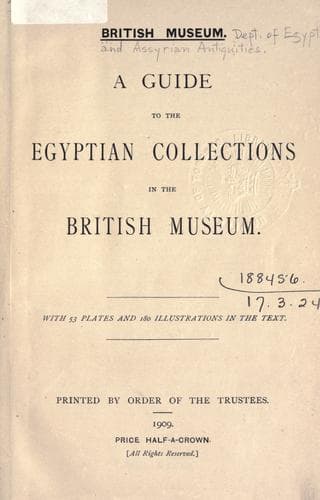
A guide to the Egyptian collections in the British Museum — John Shaqi
A guide to the Egyptian collections in the British MuseumBritish Museum. Department of Egyptian and Assyrian Antiquities
History
A guide to the Egyptian collections in the British Museum
British Museum. Department of Egyptian and Assyrian Antiquities
Egypt -- Antiquities
The dynastic Egyptians appear to have regarded a country, or district,
called =Pun= 𓊪𓃹𓈖𓏏𓈉 as their original home, and they certainly
preserved down to the latest times some of the peculiarities in dress
of the primitive inhabitants of that region. That Punt was situated a
considerable distance to the south of Egypt is certain, and that it could
be reached by land, and also by water by way of the Red Sea, is clear
from the inscriptions, but there is no evidence available which enables
the exact limits of the country to be defined. The despatch of several
expeditions to Punt by the Egyptians is recorded, for the purpose of
bringing back _ānti_ spice, 𓂝𓈖𓅂𓏊𓏧, or myrrh, which was used freely for
embalming purposes. They started from some point on the Red Sea near
the modern town of Ḳuṣêr, and sailed southwards until they reached the
river of the port of Punt which was situated on the east coast of Africa,
probably in Somaliland. The expedition despatched by Queen Ḥātshepset
about B.C. 1550 brought back boomerangs, a huge pile of myrrh, logs
of ebony, elephants’ tusks, sweet-smelling woods, eye-paint, various
kinds of spices, dog-headed apes, monkeys, leopard (or panther) skins,
“green” (_i.e._, pale) gold, and gold rings which are to this day used
as currency in East Africa and are known as “ring money.” Now, all these
things are products of the region which lies between the southern end
of the Red Sea, the Indian Ocean, and the Valley of the Nile, and it
is impossible not to conclude that Punt was situated somewhere in it.
The Egyptian expeditions probably sailed up a river for a considerable
distance, to a point where the products of Punt were brought by trading
caravans for export, and there the Egyptians bartered for the myrrh,
etc., which they required. The market place must have been inland, for
the huts of the natives are represented in the bas-reliefs as standing
close to the river.
Public-domain text, read in full here on John Shaqi.
Reviews
Reviews
No reviews yet
Be the first to share your thoughts on this work.
Join the Discussion
Join the discussion
Sign in to leave a comment or review.
Sign InorCreate an account