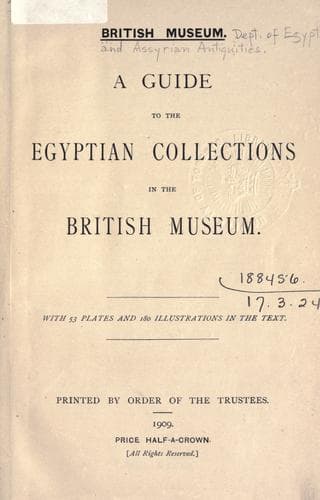
A guide to the Egyptian collections in the British MuseumBritish Museum. Department of Egyptian and Assyrian Antiquities
History
A guide to the Egyptian collections in the British Museum
British Museum. Department of Egyptian and Assyrian Antiquities
Egypt -- Antiquities
All classes were intensely =superstitious=, and they believed firmly
in the existence of =spirits=, good and bad, =witches=, and fiends and
devils, which they tried to cajole, or wheedle, or placate with gifts,
or to vanquish by means of =spells=, =magical names=, =words of power=,
=amulets= of all kinds, etc. The =magician= was the real priest, to the
lower classes at least, as he is to this day in Central Africa, for by
the use of =magical figures= he assured his clients that he could procure
for them the death, or sickness, of an enemy, riches, the love of women,
dreams wherein the future would be revealed to them, and above all,
the assistance of the gods. We find that about B.C. 312 a service was
regularly performed in the temple of Ȧmen-Rā at Thebes to make the sun
rise. In the course of it a figure of the monster Āpep, who was supposed
to be lying in wait to swallow the Sun-god, was made of wax, then wrapped
in new papyrus on which the “accursed name” of the fiend was written in
green ink, and solemnly burned in a fire fed by a special kind of herb,
whilst the priest spurned it with his left foot and poured out curses on
each of the thirty “accursed names” of the evil one. As the wax melted
and was consumed, together with the papyrus and the green ink with which
his name was written, so the body of Āpep was believed to be consumed in
the flames of the rising sun in the eastern sky.
[Illustration: The spearing of Āpep.]
From the evidence given at Thebes about B.C. 1200 against certain
officials who were implicated in a case of conspiracy against Rameses
III, it appeared that a certain man had stolen a book of magic from the
temple library. From this he obtained instructions how to make the wax
figures which caused the sickness, quakings of the limbs, and death of
those in whose forms they were made. An example of the wax figures which
were used in the Ptolemaïc period is exhibited in Table-case C in the
Third Egyptian Room, No. 198. The core is made of inscribed papyrus,
and in front, in the centre, is a piece of hair, presumably that of
the person on whom the magician who made the figure sought to exert
his influence. Every act of daily life had some magical or religious
observance associated with it, and every day, either in whole or in part,
was declared to be lucky or unlucky, in accordance with a series of
events which were represented by the =Calendar of lucky and unlucky days=.
Public-domain text, read in full here on John Shaqi.
Reviews
Reviews
No reviews yet
Be the first to share your thoughts on this work.
Join the Discussion
Join the discussion
Sign in to leave a comment or review.
Sign InorCreate an account