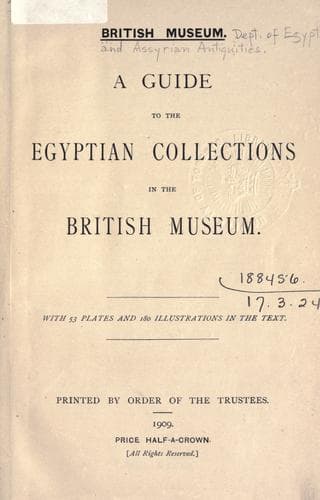
A guide to the Egyptian collections in the British MuseumBritish Museum. Department of Egyptian and Assyrian Antiquities
History
A guide to the Egyptian collections in the British Museum
British Museum. Department of Egyptian and Assyrian Antiquities
Egypt -- Antiquities
Superstition played as prominent a part in =medicine= as in religion. The
practice of dismembering the dead in primitive times must have taught
the Egyptians some practical anatomy, and the operations connected with
mummification in the later period must have added largely to their
knowledge of the arrangement of the principal internal organs of the
body. The Egyptians were well acquainted with the importance of the
heart in the human economy, and they appear to have had some knowledge
of the functions of the arteries. A considerable number of =medical
prescriptions= have come down to us, _e.g._, those which are inscribed on
a papyrus in the British Museum (No. 10,059) and are said to be as old
as the time of Khufu (Cheops), a king of the IVth dynasty, and those of
the Ebers Papyrus, of the XVIIIth dynasty; from these it is easy to see
that they closely resemble in many particulars the prescriptions given in
English medical books printed two or three hundred years ago. Powders and
decoctions made from plants and seeds were largely used, and the piths of
certain trees, dates, sycamore-figs, and other fruits, salt, magnesia,
oil, honey, sweet beer, formed the principal ingredients of many
prescriptions. With these were often mixed substances of an unpleasant
nature, _e.g._, bone dust, rancid fat, the droppings of animals, etc. In
order that certain drugs might have the desired effect it was necessary
for the physician to recite a magical formula four times (Ebers Papyrus
CVIII). Other medicines again owed their efficacy to the belief that
they had been actually taken by one or other of the gods whilst they
reigned upon earth, and the authorship of certain prescriptions was
ascribed to Rā. Thus according to the Ebers Papyrus (XLVI) Rā suffered
from attacks of boils of a most malignant kind, and he made up a salve,
containing sixteen ingredients, which gave him instant relief, and which
was therefore certain to cure ordinary mortals. The following is a
characteristic example of a prescription which, as is evident, contains a
number of substances which are well known to be good for inflamed eyes,
and also some others the special value of which is not clear:—
𓎡𓏏𓈖𓏏𓂧𓂋𓂡𓇉𓄿𓍘𓏭𓅓𓁹𓏏𓏤
“Another [prescription] for driving inflammation from the eye.
𓂝𓈖𓅂𓈒𓏦
Myrrh 1
𓎃𓏤𓏜𓏪𓅨𓂋𓈒𓏦
‘Great Protectors’ seed 1
𓍱𓊃𓇌𓏏𓈒
Oxide of copper 1
𓍑𓄿𓂋𓏏𓈒𓏦
Citron pips 1
𓎼𓄿𓇌𓏏𓆰𓎖𓏲𓏰
Northern cypress flowers 1
𓇅𓏲𓈒𓏪
Antimony 1
𓈎𓄿𓇌𓏏𓐎𓏪𓈖𓏏𓎼𓎛𓋴𓄛
Gazelle droppings 1
𓏶𓅓𓏭𓈖𓈎𓄿𓂧𓇌𓏏𓄛
Oryx offal 1
𓌻𓂋𓎛𓏏𓏊𓏪𓌉𓆓𓏏𓇳
White oil 1
[_Directions for use._]
𓂞𓁷𓏤𓈗𓁀 𓂜𓐎𓂝 𓁷𓂋𓋴𓂋𓇳𓏽𓎡𓇌𓆓𓂧 𓎘𓎛𓏲𓂡𓐍𓂋𓎡𓋴𓏏𓅓 𓆄𓆃𓈖𓏏𓈖𓂋𓏏𓅬
Public-domain text, read in full here on John Shaqi.
Reviews
Reviews
No reviews yet
Be the first to share your thoughts on this work.
Join the Discussion
Join the discussion
Sign in to leave a comment or review.
Sign InorCreate an account