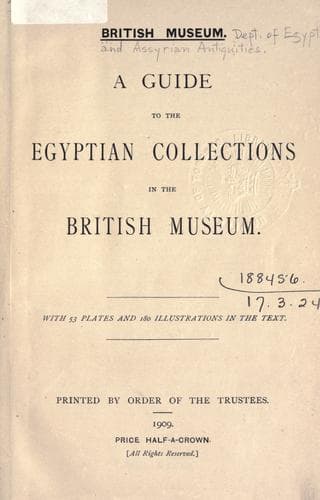
A guide to the Egyptian collections in the British Museum — John Shaqi
A guide to the Egyptian collections in the British MuseumBritish Museum. Department of Egyptian and Assyrian Antiquities
History
A guide to the Egyptian collections in the British Museum
British Museum. Department of Egyptian and Assyrian Antiquities
Egypt -- Antiquities
Between the end of the XXIInd and the beginning of the XXVIth dynasty the
scribes, wishing to simplify hieratic still further, constructed from it
a purely conventional system of signs from which most of the prominent
characteristics of the hieroglyphic, or pictures, that had been preserved
in the hieratic characters, disappeared. This new form of writing was
called =demotic= (_i.e._, the people’s writing), but it was known among
some of the early Egyptologists as =enchorial= (_i.e._, native writing,
or writing of the country). On the Rosetta Stone (Egyptian Gallery, No.
960) the visitor will see an example of the =hieroglyphic and demotic=
forms of writing placed one above the other, and in the text we find that
the hieroglyphic portion is called “the writing of the divine words,” or
letters, 𓏟𓈖𓊹𓌃𓏪, and the demotic “the writing of books,” _i.e._, rolls
of papyrus, 𓏟𓋔𓈚𓂝𓇌𓍽. The invention of the art of writing was assigned
to the god Thoth, who was the great scribe of the gods, and who is
frequently represented holding a writing palette and a reed pen, and the
hieroglyphics, or picture signs, were, therefore, called “divine, sacred,
or holy.” Hieroglyphics were used for monumental purposes until about the
end of the third century A.D., but it is tolerably certain that very few
people could read them or understand them.
[Illustration: Demotic Writing.]
During the Ptolemaïc Period, though =Greek= was the language of the
kings and the upper classes of the country, the temples were covered
with inscriptions in hieroglyphics, and the Ptolemies and the Romans
adopted old Egyptian titles, and had their names transcribed into
hieroglyphics and cut in cartouches like the Pharaohs. In the reigns
of Euergetes I (B.C. 267 to 222) and Epiphanes (B.C. 205 to 181) the
priests promulgated decrees in honour of their kings which were cut on
slabs of basalt in the hieroglyphic, demotic, and Greek characters, but
on the sepulchral tablets of the period the inscriptions are usually in
hieroglyphics alone, because the natives throughout the country clung
to these characters, which had, from time immemorial, been associated
with their religious beliefs and ceremonies. In the Southern Egyptian
Gallery, however, are exhibited several tablets which are inscribed in
demotic as well as in hieroglyphics, and of these may be noted the tablet
of Tut-i-em-ḥetep (No. 1028, Bay 25), who died B.C. 118; the tablet of
Khā-em-ḥrȧ (No. 997, Bay 25); and the tablet of Peṭā Bast (No. 1030,
Bay 27). In the Roman Period we find that the use of demotic sometimes
superseded that of hieroglyphics in public documents, and as an example
of this may be mentioned the fine sandstone tablet inscribed, wholly in
demotic, with a decree recording the dedication of certain properties
to the gods who were worshipped at Karnak (Thebes) in the first century
of our era (No. 993, Bay 27). This tablet was found at Karnak, in the
Public-domain text, read in full here on John Shaqi.
Reviews
Reviews
No reviews yet
Be the first to share your thoughts on this work.
Join the Discussion
Join the discussion
Sign in to leave a comment or review.
Sign InorCreate an account