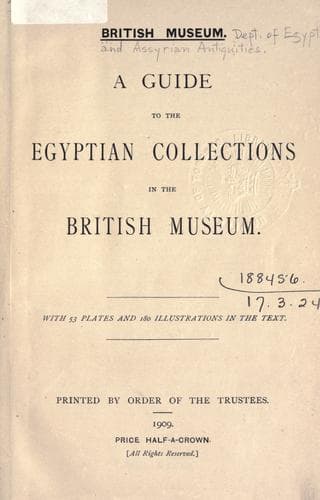
A guide to the Egyptian collections in the British MuseumBritish Museum. Department of Egyptian and Assyrian Antiquities
History
A guide to the Egyptian collections in the British Museum
British Museum. Department of Egyptian and Assyrian Antiquities
Egypt -- Antiquities
4. The ordinary language of the country, after Christianity was
introduced into it; this is called =Coptic=. It ceased to be used in
Egypt as a spoken language, probably about the twelfth century, but the
Holy Scriptures and the Services are in several places in Egypt read in
Coptic on Sundays and Festivals, although very few people understand
what is being read. Four dialects of Coptic are distinguished: (1)
That of Upper Egypt, called “Sahidic.” (2) That of Lower Egypt, called
“Boheiric.” (3) The dialect of Ṣûhâḳ and its neighbourhood. (4) The
dialect of the district of the Fayyûm. It is a noteworthy fact that,
from the beginning of the second century of our era to the twelfth, the
language of ancient Egypt was preserved, in a modified form, chiefly
through the translations of the Holy Scriptures, which were made from
Greek into Coptic.
[Illustration: A page of hieratic writing from the Great Harris Papyrus.]
=Egyptian Writing= was of three kinds, which are called “Hieroglyphic,”
“Hieratic,” and “Demotic.” The oldest form is the =hieroglyphic= (_i.e._,
sacred engraved writing), or purely pictorial, which was employed in
inscriptions upon temples, tombs, statues, sepulchral tablets, etc.,
and for monumental purposes generally. At a very early period it was
found that the hieroglyphic form of writing was cumbrous, and that in
cases where it was important to write quickly on papyrus, the pictorial
characters were inconvenient. The scribes, therefore, began first to
modify, and secondly to abbreviate the pictorial characters, and at
length the form of writing called =hieratic= (_i.e._, the priests’
writing) was developed. Hieratic was a style of cursive writing much
used by the priests in copying literary compositions on papyrus from
the IVth or Vth dynasty to the XXVIth dynasty. This form of writing is
well illustrated by the above reproduction of a page from the Great
Harris Papyrus in the British Museum (No. 9999), which was written about
B.C. 1200. The text is read from right to left, and the following is a
transcript into hieroglyphic characters of the first two lines:—
1. 𓆓𓂧𓇋𓈖𓇓𓏏𓈖𓀭𓍹𓇳𓄊𓌷𓏏𓆄𓌻𓇋𓏠𓈖𓀭𓍺𓀭𓋹𓍑𓋴
𓅮𓄿𓊹𓀭𓉻𓏛𓐍𓂋𓀙𓏲𓀀𓏪𓄂𓏏𓏲𓏭𓏴𓂻𓀀𓏪𓏌𓏤𓇾𓏤𓈇𓀎𓀀𓏪
𓈖𓏏𓎛𓏏𓂋𓇋𓆳𓄛𓏦𓆷𓄿𓏭𓂋𓂧𓏤𓄿𓈖𓄿𓌙𓀀𓏪𓌔𓏏𓏤𓀀𓏪𓆈𓏏𓏦
2. 𓋹𓈖𓐍𓏲𓀀𓏥𓎟𓏌𓏤𓇾𓏤𓈇𓈖𓇾𓏤𓈇𓌻𓇋𓆳𓊖𓊖𓄔𓅓𓏜𓏲𓈖𓏦𓂞𓏲𓀭
𓂝𓌴𓄿𓅓𓏲𓁻𓏏𓈖𓏦𓅓𓈖𓄿𓇌𓏪𓀭𓅜𓐍𓏲𓏜𓏪𓇋𓀁𓁹𓂋𓏲𓀭𓇋𓏲
𓀭𓅓𓇓𓏏𓈖𓀭𓈖𓂋𓐍𓇌𓅛𓀀𓁐𓏪𓃹𓈖𓅮𓄿𓇾𓏤𓈇𓈖
Public-domain text, read in full here on John Shaqi.
Reviews
Reviews
No reviews yet
Be the first to share your thoughts on this work.
Join the Discussion
Join the discussion
Sign in to leave a comment or review.
Sign InorCreate an account