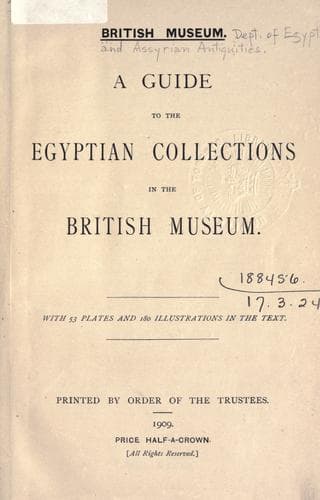
A guide to the Egyptian collections in the British MuseumBritish Museum. Department of Egyptian and Assyrian Antiquities
History
A guide to the Egyptian collections in the British Museum
British Museum. Department of Egyptian and Assyrian Antiquities
Egypt -- Antiquities
The =first translation of the Greek text= was made by Du Theil and
Weston, in 1801-02, and they rightly declared that the stone was set
up as the result of a Decree passed at the General Council of Egyptian
priests assembled at Memphis to celebrate the first commemoration of the
coronation of =Ptolemy V, Epiphanes=, king of all Egypt. The young king
had been crowned in the eighth year of his reign, therefore the first
commemoration took place in the ninth year, in the spring of the year,
B.C. 196. The Decree sets forth that, because the king had given corn and
money from his private resources to the temples, and had remitted taxes
and released prisoners, and had abolished the press-gang and restored the
worship of the gods, etc., the priests decreed that: Additional honours
be paid to the king and his ancestors; an image of the king be set up in
every temple; a statue and shrine be set up in every temple; a monthly
festival be established on the birthday and coronation day of the king;
this Decree be engraved upon a hard stone stele in the writing of the
priests (hieroglyphic), in the writing of books (demotic), and in the
writing of the Greeks (Greek), and set up in every temple of the first,
second, and third class, by the side of the image of the king.
In 1802 =Åkerblad= succeeded in making out the general meaning of
several lines of the demotic text, and in identifying the equivalents of
the names Alexander, Alexandria, Ptolemy, etc. In 1819 =Thomas Young=
published in the _Encyclopaedia Britannica_, vol. IV, the results of his
studies of the texts, and among them was a list of several alphabetic
Egyptian characters to which, in most cases, he had assigned correct
values. He was the first to grasp the idea of a =phonetic principle=
in the reading of the Egyptian hieroglyphics, and he was the first to
apply it to their decipherment. Warburton, De Guignes, Barthélemy and
Zoëga all _suspected_ the existence of alphabetic hieroglyphics, and
the three last-named scholars believed that the oval, or _cartouche_ 𓍷,
contained a royal name; but it was Young who first proved both points
and successfully deciphered the name of =Ptolemy= on the Rosetta Stone,
and that of =Berenice= on another monument, and it was Bankes who first
identified the name of =Cleopatra=. The list of alphabetic characters was
much enlarged in 1822 by the eminent scholar =Champollion=, who not only
correctly deciphered the names and titles of most of the Roman Emperors,
but drew up classified lists of the hieroglyphics, and formulated a
system of grammar and general decipherment which is the foundation upon
which all subsequent Egyptologists have worked. The discovery of the
correct alphabetic values of Egyptian signs was most useful for reading
names, but, for translating the language, a competent knowledge of
Coptic was required. Now Coptic is only another name for Egyptian.
The Egyptian Christians are called “Copts,” and the Holy Scriptures,
Public-domain text, read in full here on John Shaqi.
Reviews
Reviews
No reviews yet
Be the first to share your thoughts on this work.
Join the Discussion
Join the discussion
Sign in to leave a comment or review.
Sign InorCreate an account