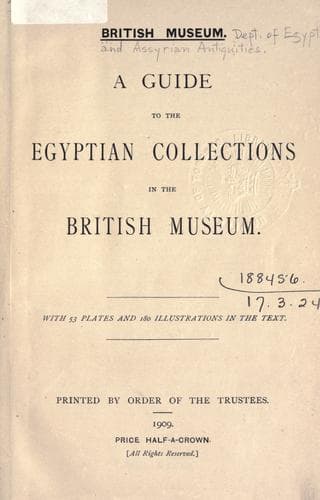
A guide to the Egyptian collections in the British MuseumBritish Museum. Department of Egyptian and Assyrian Antiquities
History
A guide to the Egyptian collections in the British Museum
British Museum. Department of Egyptian and Assyrian Antiquities
Egypt -- Antiquities
Liturgies, etc., which they translated from Greek soon after their
conversion to Christianity, are said to be written in “Coptic.” The
knowledge of Coptic has never been lost, and a comparatively large sacred
literature has always been available for study by scholars. Champollion,
quite early in the nineteenth century, realized the great importance of
Coptic for the purpose of Egyptian decipherment, and he made himself the
greatest Coptic scholar of his time. His knowledge of Coptic was deep and
wide, and to this important qualification much of his success is due.
Having once obtained a correct value of many alphabetic and syllabic
characters, his knowledge of Coptic helped him to deduce the values of
others, and to assign meanings to Egyptian words with marvellous accuracy.
The method by which the greater part of the Egyptian alphabet was
recovered is this: It was assumed correctly that the _cartouche_ always
contained a royal name. The only _cartouche_ on the Rosetta Stone was
assumed to contain the name Ptolemy. An obelisk brought from Philae about
that time contained a hieroglyphic inscription, and a translation of
it in Greek, which mentioned two names, Ptolemy and Cleopatra, and one
of the _cartouches_ was filled with hieroglyphic characters which were
identical with those in the cartouche on the Rosetta Stone. Thus there
was good reason to believe that the _cartouche_ on the Rosetta Stone
contained the name of Ptolemy written in hieroglyphic characters. Here is
the _cartouche_ which was assumed to represent the name =Ptolemaios=, or
=Ptolemy=, the hieroglyphics being numbered (A)—
=A= 𓍹𓊪𓏏𓍯𓃭𓐝𓇌𓋴𓍺
1 2 3 4 5 6 7
and here is the _cartouche_ which was assumed to represent the name
=Cleopatra= (B)—
=B= 𓍹𓈎𓃭𓇋𓍯𓊪𓄿𓂧𓂋𓄿𓏏𓆇𓍺
1 2 3 4 5 6 7 8 9 10 11
Now in B, the first sign, 𓈎, must represent =K=; it is not found in A.
No. 2 sign, 𓃭, is identical with No. 4 sign in A. This was assumed to be
=L=. No. 3 sign, 𓇋, represents a vowel, and doubled, 𓇌, is found in A,
No. 6. No. 4 sign, 𓍯, is identical with No. 3 in A, and it must have the
value of =O= in both A and B. No. 5 sign, 𓊪, is identical with No. 1 in
A, and as A contains the name Ptolemy, the first sign, 𓊪, must be =P=.
No. 6 sign, 𓄿, is wanting in A, but its value must be =A=, because it is
the same sign as No. 9, which ends the name Kleopatra. No. 7, 𓂧, does not
occur in A, but we see it in other _cartouches_ taking the place of 𓏏 the
second letter in the name of Ptolemaios, and it must therefore be some
kind of =T=. No. 8, 𓂋, we assume is =R=, because it is the last letter
but one in the name of Kleopatra. Nos. 10 and 11 signs, 𓏏𓆇, we find
after the names of goddesses; the first of them is =T=; and the second
is a “determinative.” We now insert the alphabetic values in the two
_cartouches_ and obtain the following results:
=A= 𓍹PTOL𓐝𓇌𓋴𓍺
=B= 𓍹KL(?) OPATR(?)A𓏏𓆇𓍺
Public-domain text, read in full here on John Shaqi.
Reviews
Reviews
No reviews yet
Be the first to share your thoughts on this work.
Join the Discussion
Join the discussion
Sign in to leave a comment or review.
Sign InorCreate an account