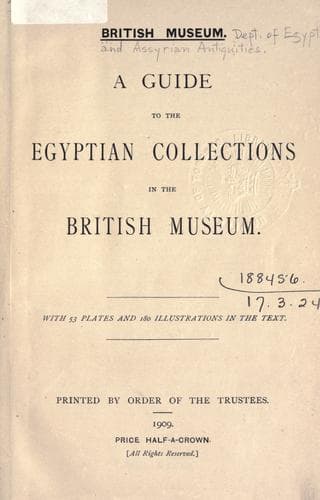
A guide to the Egyptian collections in the British MuseumBritish Museum. Department of Egyptian and Assyrian Antiquities
History
A guide to the Egyptian collections in the British Museum
British Museum. Department of Egyptian and Assyrian Antiquities
Egypt -- Antiquities
instalment of taxes for the year, signed by Severus. No. 66. Writing
exercise for the formation of letters. The Copts sometimes covered the
outside of an unbroken jar with lists, etc., _e.g._, the amphora, No.
166F, Fourth Egyptian Room, Wall-case No. 163. On this are written six
lists of names of men, with those of their fathers and mothers, and it
is probable that the inscriptions were written not later than the eighth
century.
CHAPTER III.
EGYPTIAN LITERATURE, SACRED AND PROFANE.
=Egyptian Literature.=—The literature of Ancient Egypt, written in
the hieroglyphic, hieratic, and demotic characters, is large, and the
contents of the principal divisions of it may be thus summarized:—
=Religious literature=: first and foremost is the great compilation
of texts, partly magical and partly religious, to which was given the
name “Per-em-hru,” _i.e._, the “Book of Coming Forth by Day,” or, as it
is now generally called, the =Book of the Dead=. This work is extant
in three great Recensions, viz., the Heliopolitan, Theban, and Saïte.
The =Heliopolitan Recension= consists of a series of formulas of a
semi-magical character, written in hieroglyphics, which were collected
by the priests of Ȧn, or Heliopolis, about B.C. 3300. A large number of
these formulas were in existence long before this period. The oldest
copies of texts of this Recension are found in the Pyramids of kings
Unȧs, Tetȧ, Pepi I, Meḥti-em-sa-f, and Pepi II at Ṣaḳḳârah, but series
of the formulas from it were copied on coffins and sarcophagi down to
about B.C. 200. Among such is the =coffin of Āmamu= in the British Museum
(First Egyptian Room, No. 6654). On this magnificent coffin are written
some hundreds of lines of text in black ink, and a list of canonical
offerings, according to the Liturgy of Funerary Offerings, is appended.
The coffin itself was intended to represent the chamber of a _maṣṭaba_
tomb, and on the inside are painted pictures of doors and panels, similar
to those which are found in the tombs about B.C. 3500. It is one of the
finest of its class, and it was probably made before the XIth dynasty
(B.C. 2600). In connection with this must be mentioned the portion of a
=wooden coffin of Menthuḥetep=, a king of the XIth dynasty, on which is
inscribed a version of a part of the XVIIth Chapter of the Book of the
Dead (Second Egyptian Room, Wall-cases 86-88).
Public-domain text, read in full here on John Shaqi.
Reviews
Reviews
No reviews yet
Be the first to share your thoughts on this work.
Join the Discussion
Join the discussion
Sign in to leave a comment or review.
Sign InorCreate an account