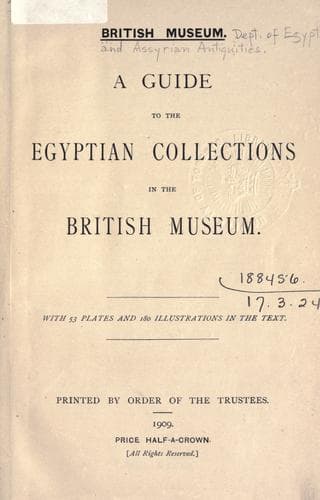
A guide to the Egyptian collections in the British MuseumBritish Museum. Department of Egyptian and Assyrian Antiquities
History
A guide to the Egyptian collections in the British Museum
British Museum. Department of Egyptian and Assyrian Antiquities
Egypt -- Antiquities
Besides papyrus, scribes frequently used =slices of white limestone= of
a fine texture, or boards plastered with lime, for writing purposes.
On these they wrote drafts of literary compositions, hymns, school
exercises, and sketches in outline of the figures of kings, gods, etc.,
made to scale. As examples may be mentioned No. 22, inscribed with the
draft of a legal document which was drawn up in connection with a robbery
of weapons from the Royal Arsenal by the Chief of the Treasury, about
B.C. 1100, and No. 41, inscribed in the hieratic character with a draft
of a part of a famous work called the “Instructions of Ȧmen-em-ḥāt I,”
king of Egypt, about B.C. 2500 (Third Egyptian Room, Table-case C). In
the Ptolemaïc Period pieces of broken earthenware vessels, or potsherds,
commonly known as =ostraka=, were much used for writing purposes. The
inscriptions on these are chiefly of a business character, receipts or
acquittances, etc.; but certain of them contain extracts from literary
works, _e.g._, a school exercise consisting of lines 105-117 and 128-139
of the _Phoenissae_ of Euripides (No. 88, Third Egyptian Room, Table-case
C). After the introduction of Christianity into Egypt, the Copts, or
Christian Egyptians, imitated their pagan ancestors, and wrote letters,
lists of objects, prayers, extracts from the Scriptures, etc., on slices
of white limestone. A fine collection of such =Coptic inscriptions= is
exhibited in the Fourth Egyptian Room, Table-case M; and of special
interest are: No. 3. Liturgical fragment. No. 5. An undertaking by
Abraham to take charge of a camel. No. 8. Religious exercise, Coptic
and Greek hymns. No. 17. Extract from Psalm xcviii, “Sing unto the Lord
a new Song,” etc. No. 19. Part of the Alexandrian Canon of the Mass,
written in corrupt Greek by Apa Eiḥannes. No. 20. Fragment containing
part of a Greek hymn and a letter in Coptic, conveying the salutations of
Dioskoros to his brother Ounaref and his mother Tnouba. No. 26. Letter
from the priest Victor and Matthaios, to Germanos and Isak (Isaac),
authorizing them to sow their share of a field, and specifying the rent.
No. 28. Document referring to the sale of a camel. It is dated on the
second of the month Pashans, and witnessed by three persons:—Dioskle
and Ouanafre[11] of Pallas, and Gergorios of Remmosh. No. 41. Part of
a letter requesting some monks to bless the writers, and to send holy
water to them that they might sprinkle their sick beasts with it. No.
53. List of measurements of land, in which Greek arithmetical signs,
etc., are employed. No. 57. Receipt for a ḥolokotinos (solidus) paid as
tax or rent by Zaêl for the “camels’ field” for the ninth year. No. 60.
School exercise in Greek and Coptic grammar; on the obverse is a portion
of a letter addressed to the authorities of a monastery. No. 61. Reading
exercise. No. 62. Fragment of a school exercise, with rough drawings
of animals. No. 65. Acquittance of Mizael Konstantinos for the first
Public-domain text, read in full here on John Shaqi.
Reviews
Reviews
No reviews yet
Be the first to share your thoughts on this work.
Join the Discussion
Join the discussion
Sign in to leave a comment or review.
Sign InorCreate an account