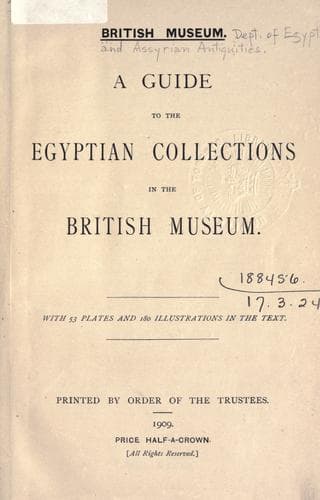
A guide to the Egyptian collections in the British MuseumBritish Museum. Department of Egyptian and Assyrian Antiquities
History
A guide to the Egyptian collections in the British Museum
British Museum. Department of Egyptian and Assyrian Antiquities
Egypt -- Antiquities
=School exercises= were written on small whitewashed boards, slices of
white limestone, and papyrus with a reed, and they usually consisted
of extracts from ancient texts, religious or poetical, the contents of
which were intended to improve the mind and form the morals and manners
of the reader and copyist. (See Standard-case C in the Third Egyptian
Room.) The education given in the =colleges of the Priests= was of a
different character. There the young men studied magical and religious
texts, several Books of the Dead, the doctrines of the cosmogony, and the
histories and legends of the gods. They read the ancient writings with
the priests whose duty it was to instruct them, and learned by heart
their expositions of the traditions accepted in the temples. One would
expect the colleges to have possessed glossaries, or dictionaries, and
grammars, but it is doubtful if they did, for nothing of the kind has
hitherto been discovered. =History= in the modern sense of the word was
unknown, though some of the great kings caused =Annals= of their reigns
to be written; and recent excavations have shown that even the =King
Lists= which were drawn up under the XVIIIth and XIXth dynasties are
incomplete, and that they contain the names of some kings wrongly spelt.
=Astronomy= was studied with some success by the priests, and the maps
of stars which were compiled by them were undoubtedly used for practical
purposes in connexion with the agriculture of the country.
[Illustration: Head of a seated figure of a priestess wearing a
full-plaited wig, bandlet, etc.
XVIIIth dynasty.
[Wall-case 103, Third Egyptian Room.]]
[Illustration: PLATE IX.
Painted relief with scenes representing dancing, the slaughter of cattle,
preparations for a feast, etc. From the tomb of Ur-ȧri-en-Ptaḥ.
VIth dynasty.
[Assyrian Basement, No. 80.]]
[Illustration: PLATE X.
Painted sepulchral tablet of Kaḥu, a scribe of a storehouse of Ȧmen.
XVIIIth dynasty.
[Northern Egyptian Gallery, Bay 12, No. 514.]]
Public-domain text, read in full here on John Shaqi.
Reviews
Reviews
No reviews yet
Be the first to share your thoughts on this work.
Elsewhere in the archive
Join the Discussion
Join the discussion
Sign in to leave a comment or review.
Sign InorCreate an account