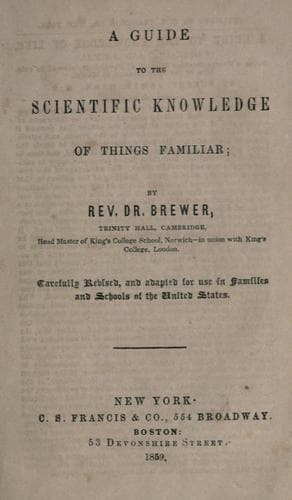
A Guide to the Scientific Knowledge of Things FamiliarBrewer, Ebenezer Cobham
Science
A Guide to the Scientific Knowledge of Things Familiar
Brewer, Ebenezer Cobham
Science -- Juvenile literature
A. Because the mercury in the tube _rises and falls_, as the air becomes
lighter or heavier: and we can generally tell by the _weight_ of the
air, what kind of weather to expect.
Q. _Does the WEIGHT of the air VARY MUCH?_
A. Yes; the atmosphere in England varies as much as _one-tenth part_
more or less.
Q. _What is the chief USE of a BAROMETER?_
A. To warn _sailors_ how to _regulate their ships_, before squalls come
on.
Q. _How can a BAROMETER warn SAILORS to regulate their SHIPS?_
A. As the barometer will tell when _wind_, _rain_, or _storm_ is at
hand, the sailor can make his ship trim before it overtakes him.
Q. _Are there any RULES which can be depended on?_
A. Yes; there are _ten special rules_ to direct us how to know the
changes of weather, by marking the mercury of a barometer.
Q. _What is the 1ST SPECIAL RULE in regard to the barometer?_
A. The barometer is _highest of all_ during a _long frost_; and it
generally rises with a _north-east wind_.
Q. _Why is the barometer HIGHEST of all during a long FROST?_
A. Because long frost _condenses the air very greatly_; and the more air
is _condensed_, the greater is its _pressure_ on the mercury of the
barometer.
Q. _Why does the barometer generally RISE with a NORTH-EAST wind?_
A. Because NORTH-EAST winds make the air both _cold and dry_: the air,
therefore, is both _condensed_, and _without vapour_.
Q. _What is the 2ND SPECIAL RULE in regard to the barometer?_
A. The barometer is _lowest of all_ during a _thaw which follows a long
frost_: it generally falls with SOUTH and WESTERN winds.
Q. _Why does the barometer fall LOWEST of all at the BREAKING UP of a
long FROST?_
A. 1st--Because the air (which had been much _dried_ by the frost)
_absorbs the moisture_ of the fresh warm current of wind from the south
or south-west: and
2ndly--The air (which had been much _condensed_ by the frost) is
suddenly _expanded_ by the warm wind which is introduced.
Q. _Why does the barometer fall very low with SOUTH and WEST winds?_
A. Because SOUTH and WEST winds come heavily _laden with vapour_; and
_vaporized_ air is lighter than _dry air_.
Q. _What effect has WIND on the mercury?_
A. _All_ winds make the barometer _drop_, except EASTERN winds: those
winds which blow from the SOUTH, and SOUTH-WEST make it _drop the
lowest_.
Q. _Why do WINDS generally make the mercury of a barometer DROP?_
A. Wind is caused by a _partial vacuum_ in some parts of the globe; and
as the air _rushes in_ to supply this deficiency, _its general pressure
is lessened_, and the barometer falls.
Q. _What is the 3RD SPECIAL RULE in regard to the barometer?_
A. While the barometer stands above 30°, the air must be very _dry_ or
very _cold_, or perhaps _both_, and _no rain_ may be expected.
Q. _Why will there be NO RAIN if the AIR be very DRY?_
A. If the air be very _dry_ it will _absorb moisture_, and not part with
what it has _in rain_.
Q. _Why will there be NO RAIN if the AIR be very COLD?_
Public-domain text, read in full here on John Shaqi.
Reviews
Reviews
No reviews yet
Be the first to share your thoughts on this work.
Elsewhere in the archive
Join the Discussion
Join the discussion
Sign in to leave a comment or review.
Sign InorCreate an account