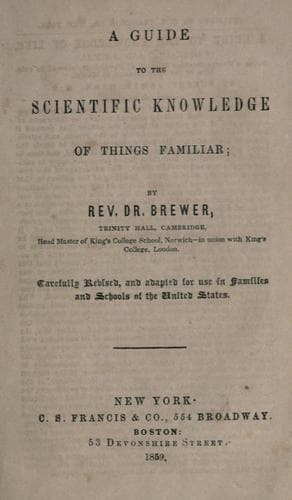
A Guide to the Scientific Knowledge of Things FamiliarBrewer, Ebenezer Cobham
Science
A Guide to the Scientific Knowledge of Things Familiar
Brewer, Ebenezer Cobham
Science -- Juvenile literature
A. If the air be very _cold_ it is _so much condensed_, that it has
already parted with as much moisture as it can spare.
Q. _What is the 4TH SPECIAL RULE in regard to the barometer?_
A. When the barometer stands _very low_ indeed, there is never _much_
rain, although a _fine day_ will seldom occur at such times.
Q. _What kind of WEATHER will it be when the barometer is UNUSUALLY
LOW?_
A. There will be _short heavy showers_, with sudden _squalls of wind_
from the _west_.
Q. _Why will there be VERY LITTLE RAIN if the barometer be UNUSUALLY
LOW?_
A. Because the air must be very _warm_, or very _moist_, or perhaps
_both_.
Q. _Why will there be little or no rain, if the_ AIR _be very_ WARM?
A. If the air be very warm it will have a tendency to _imbibe more
moisture_, and not to part with what it has.
Q. _Why will there be little or no rain if the air be MOIST, and the
barometer remains very LOW?_
A. If the air be ever so moist, rain will never fall till _cold air_ has
been introduced to _condense the vapour_; and the moment that the _cold_
air is introduced, the barometer will _rise_.
Q. _What is the 5TH SPECIAL RULE in regard to the barometer?_
A. In summer-time (after a long continuance of fair weather) the
barometer will _fall gradually_ for 2 or 3 days before _rain_ comes; but
if the fall of the mercury be very _sudden_, a _thunder-storm_ is at
hand.
Q. _What is the 6TH SPECIAL RULE in regard to the barometer?_
A. When the sky is cloudless, and seems to promise fair weather, if the
barometer be _low_, the face of the sky will soon be suddenly
_overcast_.
Q. _What is the 7TH SPECIAL RULE in regard to the barometer?_
A. Dark dense clouds will pass over _without rain_, when the barometer
is _high_; but if the barometer be low, it will often rain _without any
gathering of clouds_.
Q. _What is the 8TH SPECIAL RULE in regard to the barometer?_
A. The _higher_ the barometer, the greater is the probability of _fair
weather_.
Q. _Why is the barometer HIGH in FINE weather?_
A. Because the air contains but _very little vapour_. The _drier_ the
air, the _higher_ does the mercury of the barometer rise.
Q. _What is the 9TH SPECIAL RULE in regard to the barometer?_
A. When the mercury is in a _rising_ state, _fine_ weather is at hand;
but when the mercury is in a _sinking_ state, _foul_ weather is near.
Q. _Why does the mercury RISE at the approach of FINE weather?_
A. Because the air is becoming more _dry_, and therefore its _pressure_
is greater.
Q. _Why does the mercury SINK at the approach of FOUL weather?_
A. Because the air is _laden with vapour_, or _disturbed by wind_.
Q. _Why does VAPOUR in the air make the mercury SINK?_
A. Because vaporized air is _lighter than dry air_, and therefore its
_pressure is less_ on the mercury of the barometer.
Q. _What is the 10TH SPECIAL RULE in regard to the barometer?_
Public-domain text, read in full here on John Shaqi.
Reviews
Reviews
No reviews yet
Be the first to share your thoughts on this work.
Elsewhere in the archive
Join the Discussion
Join the discussion
Sign in to leave a comment or review.
Sign InorCreate an account