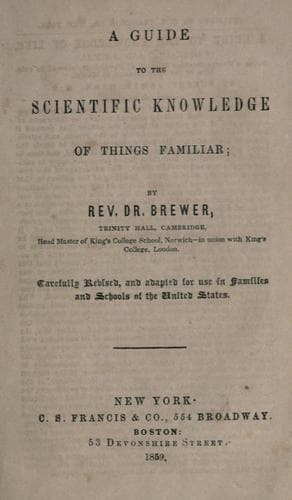
A Guide to the Scientific Knowledge of Things FamiliarBrewer, Ebenezer Cobham
Science
A Guide to the Scientific Knowledge of Things Familiar
Brewer, Ebenezer Cobham
Science -- Juvenile literature
A. If (in frosty weather) it _begins to snow_, the barometer generally
rises to 32°, where it remains as long as the snow continues to fall;
if, after this, the weather _clear up_, you may expect _very severe
cold_.
Q. _How can you know if the MERCURY of the barometer be RISING?_
A. If it be _convex_ (i. e. higher in the _middle_ than at the _sides_;)
it is in a _rising state_.
Q. _How can you tell if the MERCURY of the barometer be about to FALL?_
A. If it be _concave_ (i. e. _hollow_ in the _middle_) it is in a
_falling state_.
Q. _Why is the mercury CONVEX when it is RISING?_
A. The sides of the mercury _rub against the glass tube_, and are
_delayed_ by it, so that the _middle_ part _rises faster_ than the
_sides_.
Q. _Why is the mercury CONCAVE when it is FALLING?_
A. The sides of the mercury _rub against the glass tube_, and are
_delayed_ by it, so that the _middle_ part _sinks faster_ than the
_sides_.
Q. _What effect does a THUNDER-STORM produce on the weather?_
A. Thunder is generally _preceded by hot_ weather, and _followed by
cold_ and showery weather.
Q. _What effect does a SUDDEN CHANGE produce on the weather?_
A. A great and sudden change (either from hot to cold, or from cold to
hot) is generally followed _by rain within 24 hours_.
Q. _Why is a sudden CHANGE from HOT to COLD followed by RAIN?_
A. The cold _condenses the air_ and its vapour; which, being condensed
and squeezed out, _falls in rain_.
Q. _Why is a sudden CHANGE from COLD to HOT followed by RAIN?_
A. Because the air is _quickly saturated with moisture_; and as soon as
_night_ comes on, the temperature is _lowered again_, and some of the
abundant moisture falls in rain.
Q. _Why is the air quickly SATURATED with MOISTURE, when HEAT succeeds
rapidly from COLD?_
A. Because the evaporation (which was checked by the cold) is _carried
on very rapidly_, in consequence of the _diminished pressure_ of the
air.
(N. B. The _less the pressure_ of the air, the more _rapidly it
evaporates_ moisture.)
Q. _When does the barometer VARY MOST?_
A. In winter time.
Q. _Why does the barometer vary MORE in WINTER than in SUMMER time?_
A. Because the _difference of temperature_ between the torrid and
temperate zones is _so great_, that the state of the air is perpetually
_disturbed_ by their mixing together.
Q. _When does the barometer VARY LEAST?_
A. In summer time.
Q. _Why does the barometer vary LESS in SUMMER than in WINTER time?_
A. Because the temperature of our island is _so nearly equal_ to that of
the torrid zone, that its state is _not much disturbed_ by interchange
of currents.
Q. _What effect has WIND on the barometer?_
A. NORTH and EAST winds make the mercury _rise_; all _other_ winds make
it _sink_; but SOUTH and WEST winds make it _sink lower_ than any other
winds.
Q. _Have HEAT and COLD any effect on the barometer?_
Public-domain text, read in full here on John Shaqi.
Reviews
Reviews
No reviews yet
Be the first to share your thoughts on this work.
Elsewhere in the archive
Join the Discussion
Join the discussion
Sign in to leave a comment or review.
Sign InorCreate an account