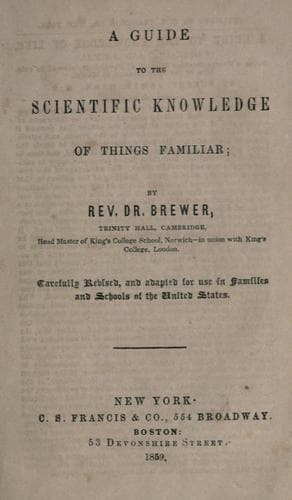
A Guide to the Scientific Knowledge of Things FamiliarBrewer, Ebenezer Cobham
Science
A Guide to the Scientific Knowledge of Things Familiar
Brewer, Ebenezer Cobham
Science -- Juvenile literature
A. No, not of _themselves_; but because _cold_ weather is generally
either _dry_, or _rough with north-east winds_, therefore the mercury
_rises_ in cold weather; and because warm weather is often _moist_ or
_fanned by south-west winds_, therefore, the mercury sinks.
Q. _Why is the mercury of a barometer LOWER in the TORRID than in the
FRIGID zones?_
A. Because the warm air of the torrid zone contains much more _vapour_
than the condensed air of the frigid zone; and the _moister_ the air,
the _less is its pressure_.
Q. _In what MONTHS is the barometer HIGHEST?_
A. In May and August; next to these, in June, March, September, and
April.
Q. _In what MONTHS is the barometer LOWEST?_
A. In November and February; then in October, July, December, and
January.
Q. _What are the DRIEST months?_
A. March and June; then May and August; then April and November.
Q. _What are the WETTEST months?_
A. October and February; then July and September; then January and
December.
Q. _Why is there LESS wet from MARCH to AUGUST, than there is from
August to March?_
A. Because the _heat is constantly increasing_; and the capacity of the
air to absorb and retain moisture increases likewise.
Q. _Why is there MORE wet from AUGUST to MARCH, than there is from March
to August?_
A. Because the _heat is constantly decreasing_, and the capacity of the
air to retain moisture decreases also; so that (although it often rains)
yet the air is always on the point of saturation.
Q. _Why does the mercury of a barometer RISE in a FROST?_
A. Because frost _condenses the air_; and condensed air is heavier than
_rarefied_ air.
Q. _Why does the mercury of a barometer FALL in a THAW?_
A. Because the air is both _warmer_ (or more rarefied), and also filled
with _vapour_.
Q. _What does a SUDDEN rise or fall of the barometer indicate?_
A. If the _rise_ be sudden, fine weather will not continue long:
If the _fall_ be sudden, foul weather will not continue long.
Q. _What sort of weather may we expect if the barometer be very
FLUCTUATING?_
A. If the mercury fluctuates much, the weather will be very _changeable
and unsettled_.
The FALL of the barometer.
In very _hot_ weather, the fall of the mercury denotes _thunder_.
Except in very hot weather, the sudden falling of the barometer denotes
high wind.
In _frosty_ weather, the fall of the barometer denotes _thaw_.
If _wet_ weather happens _soon_ after the fall of the barometer, expect
but _little_ of it.
In _wet_ weather if the barometer falls, expect much wet.
In _fair_ weather, if the barometer falls much and _remains_ low, expect
much wet in a few days, and probably _wind_.
N. B. The barometer sinks lowest of all for wind and rain together, next
to that for wind (except it be an east or north-east wind).
* * * * *
The RISE of the barometer.
In _winter_ the rise of the barometer presages _frost_.
In _frosty_ weather, the rise of the barometer presages _snow_.
Public-domain text, read in full here on John Shaqi.
Reviews
Reviews
No reviews yet
Be the first to share your thoughts on this work.
Elsewhere in the archive
Join the Discussion
Join the discussion
Sign in to leave a comment or review.
Sign InorCreate an account