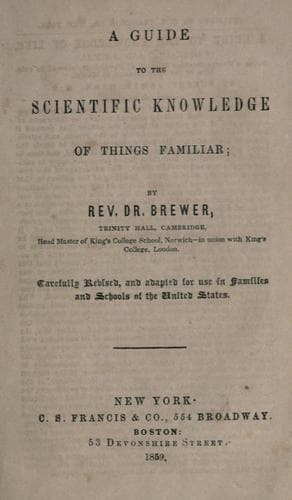
A Guide to the Scientific Knowledge of Things FamiliarBrewer, Ebenezer Cobham
Science
A Guide to the Scientific Knowledge of Things Familiar
Brewer, Ebenezer Cobham
Science -- Juvenile literature
A. Nitric acid acts very powerfully in _destroying exhalations_, arising
from putrid vegetable and animal matters.
Q. _Why is LIGHTNING more common in SUMMER and AUTUMN, than in spring
and winter?_
A. The heat of summer and autumn produces _great evaporation_; and the
conversion of _water to vapour_, always develops _electricity_.
Q. _Why does a THUNDER-STORM generally follow very DRY weather, and
rarely succeeds continued WET?_
A. The clouds are _always_ charged with electricity; but _dry air_
(being a non-conductor), will not conduct the surplus fluid from the
clouds to the earth: so it violently _rends the dry air_ with a flash,
in order to relieve the cloud, and reach the earth.
Q. _What is the general DIRECTION of a THUNDER-STORM?_
A. Either from east to west; or else from north to south.
Q. _Why is ELECTRICITY excited by FRICTION?_
A. Electricity, like heat, exists in _all_ matter; but is often in a
_latent state_: friction _disturbs_ it, and brings it into active
operation. (see p. 31.)
Q. _Why is a TREE sometimes SCORCHED by lightning, as if it had been set
on fire?_
A. Lightning scorches it by its own _positive heat_, just the same as
fire would.
Q. _Why is the BARK of a TREE often ripped quite off by a flash of
lightning?_
A. As the lightning runs down the tree, it develops the latent heat so
_rapidly_, that it carries the bark of the tree along with it, while it
seeks to escape.
Q. _Why are BOUGHS of TREES broken off by lightning?_
A. The _mechanical force_ of lightning is very great; and when the flash
strikes a tree, it will often break off the boughs by the _force_ with
which it strikes against it.
Q. _Why is an electric shock felt MOST at the ELBOW JOINT?_
A. Because the path of the fluid is _obstructed by the joint_: and the
shock felt at the elbow is caused by the fluid _leaping from one bone to
another_.
CHAPTER III.
Q. _What is the third chief source of heat?_
A. CHEMICAL ACTION.
Q. _What is meant by chemical action being the source of heat?_
A. Many things, when their chemical constitution is changed, (either by
the abstraction of some of their gases, or by the combination of others
not before united,) evolve _heat_, while the change is going on.
Q. _Explain by illustration what you mean._
A. Water is cold, and sulphuric acid is cold; but if these two _cold_
liquids be mixed together, they will produce _boiling heat_.
Q. _Why will COLD WATER, mixed with SULPHURIC ACID, produce heat?_
A. Because water (being _lighter_ than sulphuric acid), is _condensed_
by the heavier liquid; and its heat is _squeezed out_, as water from a
sponge.
Q. _Why does COLD WATER, poured on LIME, make it intensely HOT?_
A. The heat is evolved by the chemical action, produced by the cold
water combining with the lime.
Q. _Where does the heat come from?_
A. It was in the water and lime before; but was in a _latent state_.
Q. _Was there heat in the cold water and lime, before they were mixed
together?_
Public-domain text, read in full here on John Shaqi.
Reviews
Reviews
No reviews yet
Be the first to share your thoughts on this work.
Join the Discussion
Join the discussion
Sign in to leave a comment or review.
Sign InorCreate an account