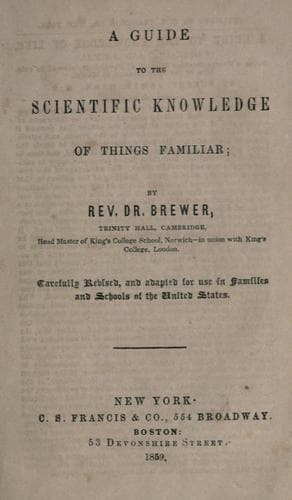
A Guide to the Scientific Knowledge of Things FamiliarBrewer, Ebenezer Cobham
Science
A Guide to the Scientific Knowledge of Things Familiar
Brewer, Ebenezer Cobham
Science -- Juvenile literature
A. Yes. _All_ bodies contain heat; the coldest ice, as well as the
hottest fire.
Q. _Is there HEAT even in ICE?_
A. Yes. But it is _latent_, (i. e. not perceptible to our senses).[4]
[4] Latent, from the Latin word, Lateo, (to lie hid.)
Q. _How do you know there is heat, if you cannot perceive it?_
A. Thus:--Ice is 32° by the thermometer; but if ice be _melted_ over a
fire, (though 140° of heat are thus absorbed,) it will feel no _hotter_
than it was before. (_i. e. it will be only 32°, and not 172°_)[5].
[5] 32°, i. e. 32 degrees; 140°, i. e. 140 degrees, &c.
Q. _What becomes of the 140°, which went into the ice to melt it?_
A. It is hidden in the water; or (to speak more scientifically) it is
stored up in a _latent state_.
Q. _How much heat may be thus secreted or made latent?_
A. _All_ things contain a vast quantity of latent heat; but, as much as
1140° of heat may remain latent in _water_.
Q. _How can 1140° of heat be added to water, without being perceptible
to our feelings?_
A. 1st--140° of heat are hidden in the water, when ice is melted by the
sun or fire.
2ndly--1000° more of heat are secreted, when water is converted into
steam. Thus, before ice is converted into steam, 1140° of heat become
_latent_.[6]
[6] Thus, one pint of boiling water, (212° according to the
thermometer,) will make 1800 pints of steam; but the steam is no hotter
to the touch than boiling water, both are 212°: therefore, when water is
converted into steam, 1000° of heat become latent. Hence, before ice is
converted to steam, it must contain 1140° of latent heat.
Q. _Can we be made to FEEL the heat of ICE or snow?_
A. Yes. Into a pint of snow put half as much salt; then plunge your hand
into the liquid; and it will feel so intensely cold, that the snow
itself will seem quite _warm_ in comparison to it.
Q. _Is SALT and SNOW really COLDER than snow?_
A. Yes, many degrees; and by dipping your hand into the mixture
_first_, and into snow _afterwards_, the mere snow will seem to be
comparatively warm.
Q. _What is FIRE?_
A. Combustion is another instance of heat, arising from chemical action.
Q. _What two things are essential to produce combustion?_
A. Fuel and air.
Q. _What are the elements of fuel?_
A. As bread is a compound of flour, yeast, and salt; so fuel is a
compound of hydrogen and carbon.
Q. _What are the ELEMENTS of atmospheric AIR?_
A. The air is a compound of oxygen and nitrogen _mixed_ together; in the
proportion of five gallons of nitrogen, to one of oxygen.
Q. _What is CARBON?_
A. The solid part of fuel. It abounds also in all animal bodies, earths,
and minerals.
Q. _Mention some different SPECIES of CARBON._
A. Common charcoal, lamp-black, coke, black lead, and the diamond, are
all varieties of carbon.
Q. _What is HYDROGEN?_
A. An inflammable gas. The gas used in our streets, is only the hydrogen
gas _driven out of coals by heat_.
Q. _What are the peculiar characteristics of hydrogen gas?_
Public-domain text, read in full here on John Shaqi.
Reviews
Reviews
No reviews yet
Be the first to share your thoughts on this work.
Join the Discussion
Join the discussion
Sign in to leave a comment or review.
Sign InorCreate an account