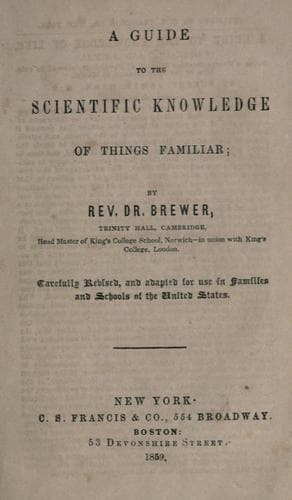
A Guide to the Scientific Knowledge of Things FamiliarBrewer, Ebenezer Cobham
Science
A Guide to the Scientific Knowledge of Things Familiar
Brewer, Ebenezer Cobham
Science -- Juvenile literature
A. The water in these hollows froze first at the _sides_ of the
foot-prints: other crystals gradually shot across the water, and would
have _covered the whole surface_, had not the earth _absorbed_ the water
before it had time to freeze.
Q. _In winter time these FOOT-MARKS and WHEEL-RUTS are sometimes covered
with a perfect SHEET of ice, and not an icy net-work,--Why is THIS?_
A. The _air being colder_ and the _earth harder_ (than in the former
case), the _entire surface_ of the foot-print is frozen over, before the
earth can _draw the water in_.
Q. _Why is not the ice SOLID in these ruts?--WHY is there only a very
thin FILM or NET-WORK of ice?_
A. Because the earth _absorbs the water_, and leaves the icy _film
behind_.
Q. _Does not water expand by HEAT as well as COLD?_
A. Yes; it expands as soon as it is more than 42 degrees _till it
boils_, and then it flies off in steam.
[Illustration: Here A B measures the bulk of a portion of water at 42
degrees.
It goes on increasing in bulk to C D, when it boils. It also goes on
increasing in bulk to E F, when it freezes.]
Q. _Why do WATER-PIPES frequently BURST in FROSTY weather?_
A. Because the water in them _freezes_; and as the water _expands by
frost_, it bursts the pipes to make room for its increased volume.
Q. _When does WATER begin to EXPAND from cold?_
A. Water (which is wisely ordained by God to be an _exception_ to a
very general rule) _contracts_ till it is reduced to 42 degrees, and
then it _expands till it freezes_.
(Water freezes at 32°.)
Q. _Why does water expand when it freezes?_
A. Because it is converted into _solid crystals_, which _do not fit
close_, like the particles of water.
Q. _Why is the water at the BOTTOM of a river NEVER FROZEN?_
A. Because when water is colder than 42 degrees, it instantly _ascends
to the surface_; and (if it freezes) _floats there_ till it is melted.
(When a river is frozen, the water below the surface is never less than
42°.)
Q. _Show the WISDOM of GOD in this wonderful exception to a general
law._
A. If ice were _heavier than water_, it would _sink_; and a river would
soon become a solid _block of ice_, which could never be dissolved.
Q. _Why does not the cold ICE on the SURFACE of a river CHILL the water
BENEATH, and make it freeze?_
A. 1st--Water is a _very bad conductor_, and is heated or chilled by
CONVECTION only:
2ndly--If the ice on the surface were to communicate its _coldness_ to
the water beneath, the _water beneath_ must communicate its _heat to the
ice_, and the ice would instantly _melt_: and
3rdly--The ice on the surface acts as a _shield_ to _prevent the cold
air from penetrating the river_ to freeze it below the mere crust.
Q. _Why does WATER FREEZE at the SURFACE first?_
A. Because the surface is in _contact with the air_, and the air
_carries away its heat_.
Q. _Why does the coat of ice grow THICKER and THICKER, if the frost
CONTINUES?_
Public-domain text, read in full here on John Shaqi.
Reviews
Reviews
No reviews yet
Be the first to share your thoughts on this work.
Elsewhere in the archive
Join the Discussion
Join the discussion
Sign in to leave a comment or review.
Sign InorCreate an account