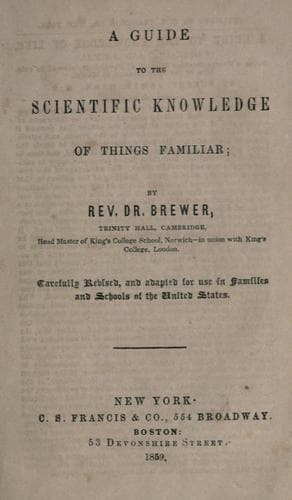
A Guide to the Scientific Knowledge of Things FamiliarBrewer, Ebenezer Cobham
Science
A Guide to the Scientific Knowledge of Things Familiar
Brewer, Ebenezer Cobham
Science -- Juvenile literature
A. Because the _heat of the water_ (immediately below the frozen
surface) _passes through the pores of the ice_ into the _cold air_.
Q. _Why then are not WHOLE RIVERS FROZEN (layer by layer) till they
become solid ice?_
A. Because water is _so slow a conductor_, that our frosts never
continue _long enough_ to convert a whole river into a solid mass of
ice.
Q. _Why does not RUNNING water freeze so fast as STILL water?_
A. 1st--Because the motion of the current _dissolves the crystals_ as
fast as they are formed; and
2ndly--The heat of the _under_ surface is more freely distributed to the
_upper_ surface by the _rolling water_.
Q. _When RUNNING water is FROZEN, why is the ICE generally very ROUGH?_
A. Because little flakes of ice are first formed and _carried down the
stream_, till they meet some _obstacle_ to _stop_ them; _other_ flakes
of ice (_impinging against them_) are arrested in like manner; and the
_edges_ of the different flakes _overlapping_ each other, _make the
surface rough_.
Q. _Why do SOME parts of a RIVER FREEZE LESS than OTHERS?_
A. Because _springs_ issue from the bottom, and (as they bubble upwards)
_thaw the ice_, or make it thin.
Q. _When persons FALL into a RIVER in winter time, why does the WATER
feel remarkably WARM?_
A. Because the _frosty air_ is at least 10 or 12 degrees _colder_ than
the water.
(The water below the surface is at least 42°; but the air 32°, or even
less.)
Q. _Why is SHALLOW water FROZEN QUICKER than DEEP water?_
A. Because (as the _whole volume_ of water must be cooled to 42 degrees
before the _surface can be frozen_) it will take a longer time to cool
down a _deep_ bed of water than a _shallow_ one.
Q. _Why is SEA-WATER RARELY FROZEN?_
A. 1st--Because the _mass of water is so great_ that it requires a very
long time to cool the whole volume down to 42 degrees:
2ndly--The _ebb and flow_ of the sea interfere with the cooling
influence of the air: and
3rdly--_Salt_ never freezes till the surface is cooled down at least 25
degrees _below the freezing point_.
Q. _Why do some LAKES RARELY if ever FREEZE?_
A. 1st--Because they are _very deep_:
2ndly--Because their water is supplied by _springs_, which bubble from
the bottom.
Q. _Why does the DEPTH of the water RETARD its FREEZING?_
A. As the _whole volume of water_ must be reduced to 42 degrees before
the _surface will freeze_, the _deeper_ the water, the _longer_ it will
be before the whole volume is thus reduced.
Q. _Why do SPRINGS at the bottom of a lake PREVENT its FREEZING?_
A. Because they keep continually sending forth _fresh water_, which
prevents the lake from being reduced to the necessary degree of
coldness.
Q. _Why is it COLDER in a THAW than in a FROST?_
A. When frozen water is _thawed_, it absorbs _heat from the air and
objects around_ to melt its ice, in consequence of which the cold is
greatly increased.
Q. _Why is it WARMER in a FROST than in a THAW?_
Public-domain text, read in full here on John Shaqi.
Reviews
Reviews
No reviews yet
Be the first to share your thoughts on this work.
Elsewhere in the archive
Join the Discussion
Join the discussion
Sign in to leave a comment or review.
Sign InorCreate an account