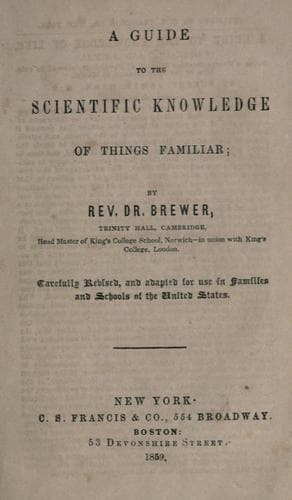
A Guide to the Scientific Knowledge of Things FamiliarBrewer, Ebenezer Cobham
Science
A Guide to the Scientific Knowledge of Things Familiar
Brewer, Ebenezer Cobham
Science -- Juvenile literature
A. When water freezes it _gives out its latent heat_, in order that it
may be converted into _solid ice_; and as much _heat is liberated_ from
the water into the air, we feel warmer.
Q. _Why does SALT DISSOLVE ICE?_
A. Water freezes at 32°, but salt and water will not freeze _till the
air is 25° colder_: if, therefore, salt be added to frozen water it
becomes _liquid_, unless the thermometer stands below 7°, (which it
never does in our island).
Q. _Will any thing do INSTEAD of SALT?_
A. Yes; any _acid_, such as sulphuric, nitric, &c.
Q. _Why are SALT and SNOW mixed together, colder than SNOW?_
A. When _salt_ is mixed with snow, it _dissolves the crystals_ into a
fluid; and whenever a solid is converted to a liquid, _heat is
absorbed_, and the cold made more intense.
Q. _Why does FROST make the EARTH CRACK?_
A. During the warm weather the earth _absorbed abundance of moisture_,
which the winter _freezes_: and (as water _expands_ by frost) the
expanding water _thrusts the particles of earth apart from each other_,
and leaves a chink or crack behind.
Q. _Show the WISDOM of GOD in this arrangement._
A. These _cracks_ in the earth let in the air, the dew and rain, and
many gases favourable to vegetation.
Q. _Why does the EARTH CRUMBLE in SPRING?_
A. In spring the _ice_ of the clods _dissolves_, and the particles of
earth (which had been held apart by the expanded ice) are left
_unsupported_, and tumble into minute parts (because their _cement is
dissolved_).
Q. _Why does MORTAR CRUMBLE away in FROST?_
A. If the mortar was not _dried in the warm weather_, its moisture
_freezes_, _expands_, and thrusts the particles of the mortar away from
each other; but (as soon as the frost goes) the _water condenses_ and
leaves the mortar full of cracks and chinks.
Q. _Why does STUCCO PEEL from a WALL in FROSTY weather?_
A. If the stucco was not _dried in the warm weather_, its moisture
_freezes_, _expands_, and thrusts its particles away from the wall; but
as soon as the water condenses again by the thaw, the stucco (being
unsupported) _falls by its own weight_.
Q. _Why cannot BRICKLAYERS and PLASTERERS work in FROSTY weather?_
A. Because the bricks and plaster would _start from their position_ as
soon as the _frost_ came and expanded the mortar.
Q. _Why do BRICKLAYERS COVER their work with STRAW in spring and
autumn?_
A. Because straw is a non-conductor, and prevents the mortar of their
new work from _freezing_ during the cold nights of spring and autumn.
Q. _Why are WATER-PIPES often covered with STALL-LITTER in winter time?_
A. Because straw (being a non-conductor) prevents the _water of the
pipes from freezing_, and the _pipes from bursting_.
Q. _Why are delicate TREES covered with STRAW in WINTER?_
A. Because straw (being a non-conductor) prevents the _sap of the tree_
from being frozen.
Q. _Can WATER be FROZEN in any way BESIDES by frosty weather?_
Public-domain text, read in full here on John Shaqi.
Reviews
Reviews
No reviews yet
Be the first to share your thoughts on this work.
Elsewhere in the archive
Join the Discussion
Join the discussion
Sign in to leave a comment or review.
Sign InorCreate an account