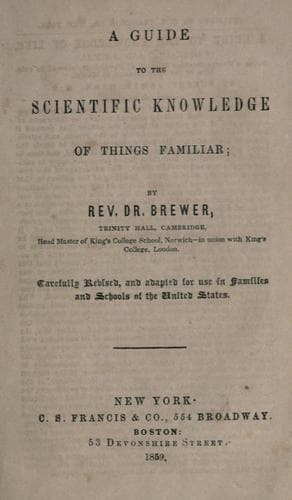
A Guide to the Scientific Knowledge of Things FamiliarBrewer, Ebenezer Cobham
Science
A Guide to the Scientific Knowledge of Things Familiar
Brewer, Ebenezer Cobham
Science -- Juvenile literature
A. Nitrogen is another invisible gas. It _will not_ burn, like hydrogen;
and an animal cannot live in it: it abounds in animal and vegetable
substances, and is the chief ingredient of the common air.[9]
[9] Nitrogen gas may easily be obtained thus:--Put a piece of burning
phosphorus on a little stand, in a plate of water; and cover a bell
glass over. (Be sure the edge of the glass stands _in the water_.) In a
few minutes the air will be decomposed, and nitrogen alone remain in the
bell glass.
(N.B. The white fume which will arise and be absorbed by the water in
this experiment, is phosphoric acid; i. e. phosphorus combined with
oxygen of the air.)
Q. _Why is there so much nitrogen in the air?_
A. In order to _dilute_ the oxygen. If the oxygen were not thus diluted,
fires would burn out, and life would be exhausted too quickly.
Q. _What three elements are necessary to produce COMBUSTION?_
A. Hydrogen gas, carbon, and oxygen gas; the two former in the _fuel_,
and the last in the _air_ which surrounds the fuel.
Q. _What causes the combustion of the fuel?_
A. The hydrogen gas of the fuel being set free, and excited by a piece
of lighted paper, instantly _unites_ with the _oxygen of the air_, and
makes a yellow flame: this flame heats the _carbon of the fuel_,
which also unites with the oxygen of the air, and produces _carbonic
acid gas_.
Q. _What is carbonic acid gas?_
A. Only carbon (or charcoal) combined with oxygen gas.
Q. _Why does FIRE produce HEAT?_
A. 1st--By liberating _latent heat_ from the air and fuel: and
2ndly--By throwing into _rapid motion_ the _atoms of matter_.
Q. _How is latent HEAT liberated by COMBUSTION?_
A. When the _oxygen_ of the air combines with the _hydrogen_ of the
fuel, the two gases _condense into water_; and latent heat is _squeezed
out_, as water from a sponge.
Q. _How are the ATOMS OF MATTER DISTURBED by COMBUSTION?_
A. 1st--When _hydrogen_ of fuel and _oxygen_ of air _condense into
water_, a _vacuum_ is made; and the air is disturbed, as a _pond_ would
be, if a pail of water were taken out of it: and
2ndly--When the _carbon_ of fuel and _oxygen_ of air _expand into
carbonic acid gas_, the air is _again_ disturbed, as it would be by
the explosion of _gunpowder_.
Q. _How does fire condense HYDROGEN and OXYGEN into WATER?_
A. The _hydrogen of fuel_ and _oxygen of air_ (liberated by combustion)
combining together, _condense into water_.
Q. _How does fire expand CARBON into CARBONIC ACID GAS?_
A. The _carbon of fuel_ and _oxygen of air_ (combining together in
combustion) expand into a gas, called _carbonic acid_.
Q. _Why is a FIRE (after it has been long burning) RED HOT?_
A. When coals are heated _throughout_, the carbon is so completely mixed
with the oxygen of the air, that the _whole surface is in a state of
combustion_, and therefore _red hot_.
Q. _In a BLAZING fire, why is the UPPER surface of the COALS BLACK, and
the LOWER surface RED?_
Public-domain text, read in full here on John Shaqi.
Reviews
Reviews
No reviews yet
Be the first to share your thoughts on this work.
Join the Discussion
Join the discussion
Sign in to leave a comment or review.
Sign InorCreate an account