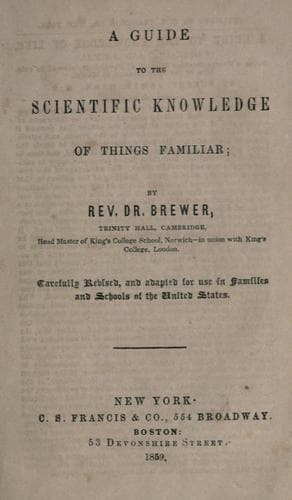
A Guide to the Scientific Knowledge of Things FamiliarBrewer, Ebenezer Cobham
Science
A Guide to the Scientific Knowledge of Things Familiar
Brewer, Ebenezer Cobham
Science -- Juvenile literature
A. Carbon (being very solid) requires a great degree of heat to make it
unite with the oxygen of the air. When fresh coals are put on, their
_under_ surface is heated before the upper surface; and one is _red_ (or
in a state of combustion), while the other is _black_.
Q. _Which burns the quicker, a BLAZING fire, or a RED HOT one?_
A. A _blazing_ fire burns out the fuel quickest.
Q. _Why do BLAZING COALS BURN QUICKER than red hot ones?_
A. In red hot coals, only the _mere surface_ is in a state of
combustion, because the carbon is _solid_; but in a _blazing_ fire,
(where the gases are escaping), the _whole volume of the coal
throughout_ is in a state of decomposition.
Q. _What is SMOKE?_
A. _Unconsumed_ parts of fuel (principally carbon), separated from the
solid mass, and carried up the chimney by the current of hot air.
Q. _Why is there MORE SMOKE when COALS are FRESH added, than when they
are red hot?_
A. Carbon (being solid), requires a great degree of heat to make it
unite with oxygen, (or, in other words, to bring it into a state of
perfect combustion): when coals are fresh laid on, _more carbon is
separated_ than can be _reduced to combustion_; and so it flies off in
smoke.
Q. _Why is there so LITTLE SMOKE with a RED HOT FIRE?_
A. When a fire is red hot, the _entire surface_ of the coals is in a
_state of combustion_; so a very little flies off unconsumed, as smoke.
Q. _Why are there DARK and BRIGHT SPOTS in a CLEAR cinder FIRE?_
A. Because the _intensity_ of the combustion is _greater in some parts_
of the fire, than it is in _others_.
Q. _Why is the intensity of the combustion so unequal?_
A. Because the air flies to the fire in various and unequal currents.
Q. _Why do we see all sorts of GROTESQUE FIGURES in hot COALS?_
A. Because the _intensity_ of combustion is so _unequal_, (owing to the
gusty manner in which the air flies to the fuel; and the various shades
of red, yellow, and white heat mingling with the black of the unburnt
coal), produce strange and fanciful resemblances.
Q. _Why does PAPER BURN more readily than wood?_
A. Merely because it is of a _more fragile texture_; and, therefore, its
component parts are more easily heated.
Q. _Why does WOOD BURN more readily than coal?_
A. Because it is not so _solid_; and, therefore, its elemental parts are
more easily separated, and made hot.
Q. _When a FIRE is LIGHTED, why is PAPER laid at the BOTTOM, against the
grate?_
A. Because paper (in consequence of its fragile texture), so very
readily catches fire.
Q. _Why is WOOD laid on the top of the paper?_
A. Because wood, (being more _substantial_), _burns longer_ than
paper; and, therefore, affords a _longer contact of flame_ to heat the
coals.
Q. _Why would not paper do without wood?_
A. Because paper burns out so _rapidly_, that it would not afford
sufficient _contact of flame_ to heat the coals to combustion.
Q. _Why would not WOOD do WITHOUT shavings, straw, or paper?_
Public-domain text, read in full here on John Shaqi.
Reviews
Reviews
No reviews yet
Be the first to share your thoughts on this work.
Join the Discussion
Join the discussion
Sign in to leave a comment or review.
Sign InorCreate an account