A Guide to the Scientific Knowledge of Things Familiar — John Shaqi
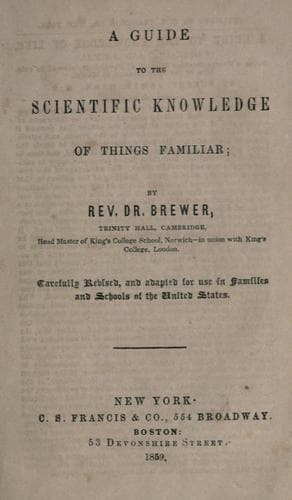
A Guide to the Scientific Knowledge of Things FamiliarBrewer, Ebenezer Cobham
Science
A Guide to the Scientific Knowledge of Things Familiar
Brewer, Ebenezer Cobham
Science -- Juvenile literature
A. Because compression _squeezes out_ heat, as water is squeezed from a
sponge; and as the goods of a large pile are greatly _compressed_, much
of their latent heat is _squeezed out_.
Q. _Why do HAY-STACKS sometimes CATCH FIRE of themselves?_
A. Either because the hay was got up _damp_, or because rain has
penetrated the stack.
Q. _Why will a HAY-STACK CATCH FIRE if the hay be damp?_
A. Damp hay soon _decays_, and undergoes a _state of fermentation_;
during which, _carbonic acid gas_ is given off, and the stack catches
_fire_.
Q. _Why does roasted COFFEE sometimes CATCH FIRE spontaneously?_
A. The _heat_ of coffee is greatly increased by being _roasted_; and the
_carbon of the coffee_ uniting with the _oxygen of the air_, produces
_carbonic acid gas_, and bursts into _flame_.
Q. _Why do old RAGS, used for CLEANING LAMPS and CANDLES, sometimes set
a HOUSE on FIRE?_
A. Because they very readily _ferment_, and (during fermentation) throw
off exceedingly inflammable gases.
(N.B. Lamp-black mixed with linseed oil is more liable to spontaneous
combustion, than anything that servants handle.)
CHAPTER IV.
SMOKE.
Q. _Why does SMOKE ASCEND the chimney?_
A. As the air of the room passes over the fire, it becomes _heated_; and
(being thus made _lighter_,) ascends the chimney, carrying the smoke
with it.
Q. _What is SMOKE?_
A. Small particles of carbon, separated by combustion from the fuel, but
not _consumed_.
Q. _Why do SMOKE and steam CURL, as they ascend?_
A. Because they are moved in a _right line_, and then _pushed on all
sides_; and this forces them into a _circular_ motion.
Q. _What are BLACKS?_
A. When the hot air of the chimney has been cooled by the _external_
air, it can no longer _buoy up_ the solid smoke; so it falls to the
earth in condensed flakes, called "blacks."
Q. _Why are there NO BLACKS in the smoke of a RAILWAY engine?_
A. The smoke of a railway engine consists chiefly of _watery vapour_,
which dissolves in air, as sugar does in water; but the smoke of a
common chimney consists of small fragments of _unburnt fuel_.
Q. _Why does a "COPPER HOLE" DRAW up more fiercely than an OPEN stove?_
A. As the air, which supplies the copper hole, must pass _through the
furnace_, it becomes exceedingly _heated_, and rushes up the chimney
with great violence.
Q. _What produces the ROARING noise made by a COPPER-HOLE fire?_
A. Air rushing rapidly through the crevices of the _iron door_, and up
the _chimney flue_.
Q. _Why is the ROAR LESS, if the copper-hole DOOR be thrown OPEN?_
A. Because _fresh_ air gets access to the fire _more easily_; and as the
air is not so intensely heated, its motion is not so _violent_.
Q. _Why do some CHIMNEYS SMOKE?_
A. If fresh air is not admitted into a room, _as fast as it is consumed
by the fire_, a current of air _will rush down the chimney_ to _supply
the deficiency_, and bring the smoke along with it.
Public-domain text, read in full here on John Shaqi.
Reviews
Reviews
No reviews yet
Be the first to share your thoughts on this work.
Join the Discussion
Join the discussion
Sign in to leave a comment or review.
Sign InorCreate an account