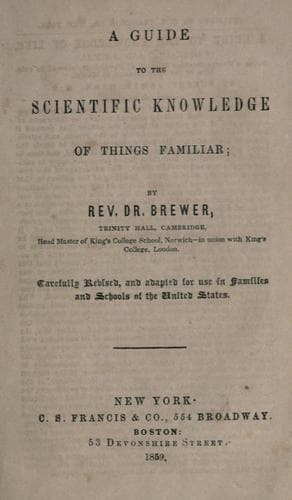
A Guide to the Scientific Knowledge of Things FamiliarBrewer, Ebenezer Cobham
Science
A Guide to the Scientific Knowledge of Things Familiar
Brewer, Ebenezer Cobham
Science -- Juvenile literature
A. The _hydrogen_ of the water will burn with a _flame_; and the
_oxygen_ of the water will increase the _intensity_ of that flame.
Q. _If a house be on fire, is too LITTLE water worse than NO water at
all?_
A. Certainly. Unless the water be supplied so plentifully as _to quench
the fire_, it will increase the _intensity_, like fuel.
Q. _When will water EXTINGUISH FIRE?_
A. When the supply is so rapid and abundant, that the fire cannot
_convert it into steam_.
Q. _Does not a very LITTLE water SLACKEN the heat of fire?_
A. Yes, _till it is converted into steam_; but then it increases the
_intensity_ of fire, and acts like fuel.
Q. _Why does the WICK of a candle (when the flame has been blown out)
CATCH FIRE so readily?_
A. As the wick is already _very hot_, a little _extra_ heat will throw
it into flame.
Q. _Why does the EXTRA heat revive the flame?_
A. Because it again liberates the _hydrogen_ of the tallow, and ignites
it.
Q. _Cannot WOOD be made to BLAZE without actual contact with fire?_
A. Yes; if a piece of wood be held _near_ the fire for a little time it
will blaze, even though it does not _touch_ the fire.
Q. _Why will WOOD BLAZE, even if it does not touch the fire?_
A. The heat of the fire _drives out the hydrogen gas_ of the wood; which
is inflamed by contact with the red-hot coals.
Q. _Why will a NEIGHBOUR'S HOUSE sometimes CATCH FIRE, though no flame
of the burning house ever touches it?_
A. The heat of the burning house sets at liberty _the hydrogen gas_ of
the neighbouring wood-work, which is ignited by the flames or red-hot
bricks of the house on fire.
Q. _What is COKE?_
A. Coal freed from its volatile gases, by the action of artificial heat.
Q. _Why do ARNOTT'S STOVES sometimes SMELL so strong of SULPHUR?_
A. The fire is made of coke, which contains sulphur; and, whenever the
draught is not rapid enough _to drive the sulphur up the flue_, it is
emitted into the room.
Q. _What is meant by SPONTANEOUS COMBUSTION?_
A. Ignition produced by the action of _one uninflamed_ body on another.
Q. _Give an example of spontaneous combustion._
A. Goods packed in a warehouse will often catch fire of _themselves_;
especially such goods as cotton, flax, hemp, rags, &c.
Q. _Why do such GOODS sometimes CATCH FIRE of themselves?_
A. Because they are piled together in very _great masses_ in a _damp_
state or place.
Q. _Why does this produce spontaneous combustion?_
A. The damp produces _decay_ or the decomposition of the goods, and the
great heat of the piled-up mass makes the decaying goods _ferment_.
Q. _How does this FERMENTATION produce COMBUSTION?_
A. During fermentation, _carbonic acid gas_ is given off by the
goods,--a slow combustion ensues,--till at length the _whole pile_
bursts into _flame_.
Q. _Why is the HEAT of a LARGE MASS of goods GREATER than that of a
smaller quantity?_
Public-domain text, read in full here on John Shaqi.
Reviews
Reviews
No reviews yet
Be the first to share your thoughts on this work.
Join the Discussion
Join the discussion
Sign in to leave a comment or review.
Sign InorCreate an account