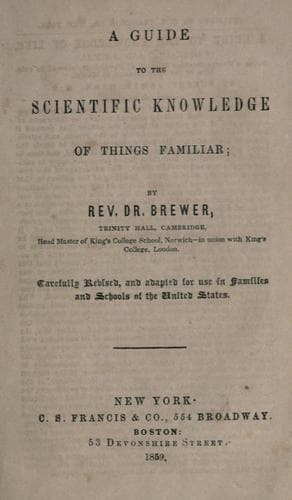
A Guide to the Scientific Knowledge of Things FamiliarBrewer, Ebenezer Cobham
Science
A Guide to the Scientific Knowledge of Things Familiar
Brewer, Ebenezer Cobham
Science -- Juvenile literature
Q. _Why is the DRAUGHT of a LONG FLUE greater than that of a short one?_
A. Because the _higher_ smoke ascends, the _faster_ it goes; (as a stone
falls faster and faster, the nearer it approaches to the earth): if,
therefore, a funnel be _long_, the smoke acquires great _velocity_, and
the _draught_ is great.
Q. _If a CHIMNEY be TOO SHORT, and cannot be lengthened, what is the
best REMEDY to prevent smoking?_
A. To _contract the opening of the chimney_ contiguous to the stove.
Q. _Why will a_ SMALLER OPENING _against the stove_ PREVENT _the_
SMOKING?
A. As all the air (which enters the chimney) _must pass near the fire_,
it will become _greatly heated_, and _rise rapidly_ through the funnel;
and this _increase of heat_ will compensate for the _shortness of the
flue_.
Q. _Why will a_ ROOM SMOKE, _if there be_ TWO FIRES _in it?_
A. Because the _fiercer_ fire will exhaust the most air; and draw from
the _smaller_ one, to supply its demand.
Q. _Why will a chimney_ SMOKE _if there be a_ FIRE _in_ TWO ROOMS
_communicating with each other?_
A. Whenever the _door_ between the two rooms _is opened_, air will rush
from the chimney of the _inferior_ fire, to supply the _other_; and
_both_ rooms will be filled with smoke.
Q. _What is the_ REMEDY _in this case?_
A. Let a tube be carried from the hearth of each stove, into the
external air; and then _each_ fire will be so _well_ supplied, that
neither will need to borrow from the other.
Q. _Why do VESTRY CHIMNEYS so often SMOKE?_
A. Because the wind (striking against the steeple) _is reflected back_;
and tumbles down the vestry chimney, forcing the smoke _into the room_.
Q. _WHAT WINDS make vestry chimneys smoke?_
A. Those from the north-east or south-east; according to the position of
the vestry.
Q. _Why will the EASTERN winds make VESTRIES SMOKE, more than those from
the west?_
A. Because they _strike against the steeple_, and _bound back_ to the
vestry chimney: but _western_ winds cannot rebound over the roof of a
church.
(N. B. The _steeple_ of a church is always due _west_, and the _other_
end of the church due _east_; if, therefore, a _western_ wind rebound,
it would rebound to the _west_, or _away from the church_, and not
towards it.)
Q. _Why does a HOUSE in a VALLEY very often SMOKE?_
A. Because the wind (striking against the surrounding hills) _rebounds
back again upon the chimney_, and destroys its draught.
Q. _What is the common REMEDY in both these cases?_
A. To fix a _cowl_ on the chimney top, to turn like a weather-cock, and
present its back to the wind.
Q. _Why will not a COWL always PREVENT a chimney SMOKING?_
A. If the wind be _strong_, it will keep the _opening_ of the cowl
_towards the steeple or hill_; and then the reflected wind will _blow
into the cowl_, and _down the chimney_.
Q. _As a cowl is such a poor remedy, can any OTHER be devised?_
A. If the chimney flue can be carried _higher_ than the steeple or
hills, no wind can enter the flue.
Public-domain text, read in full here on John Shaqi.
Reviews
Reviews
No reviews yet
Be the first to share your thoughts on this work.
Join the Discussion
Join the discussion
Sign in to leave a comment or review.
Sign InorCreate an account