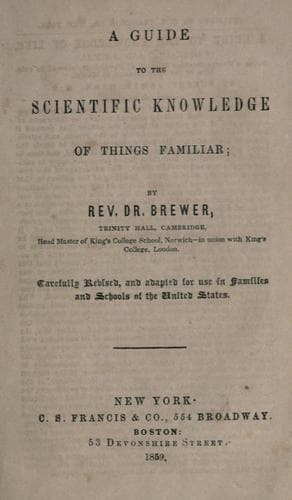
A Guide to the Scientific Knowledge of Things FamiliarBrewer, Ebenezer Cobham
Science
A Guide to the Scientific Knowledge of Things Familiar
Brewer, Ebenezer Cobham
Science -- Juvenile literature
A. Because they compel the air to go _through_ the fire, and not _over_
it; therefore the fire is well supplied with oxygen, and the draught
greatly increased.
Q. _Why does a tin BLOWER INCREASE the DRAUGHT?_
A. As all the air which enters the chimney has to pass _through_ the
fire, it is much hotter, and ascends the chimney very fast; and the
faster the air _flies up the chimney_, the faster it rushes _towards the
fire_ also.
Q. _Why does a parlour often SMELL disagreeably of SOOT in SUMMER-TIME?_
A. The air in the _chimney_ (being _colder_ than the air in the
_parlour_) _descends into the room_, and leaves a disagreeable smell of
soot behind.
Q. _Why are the CEILINGS of PUBLIC OFFICES so BLACK and filthy?_
A. The heated air ascending, carries the dust and fine soot to the
ceiling; where the hot _air_ escapes through the plaster, and _leaves
the soot and dust_ behind.
Q. _Why are SOME parts of the ceiling BLACKER and more filthy than
others?_
A. As the air cannot penetrate the thick _joists_ of the ceiling, _it
passes by those parts_, and deposits its soot and dust on those which
are more penetrable.
Q. _What is CHARCOAL?_
A. Wood which has been exposed to a red heat, till it has been deprived
of all its gases and volatile parts.
Q. _Why is a CHARCOAL FIRE hotter than a wood fire?_
A. Because so large a quantity of _water_ has been abstracted from the
fuel, by the red heat to which it has been already exposed.
Q. _Why does charcoal REMOVE the TAINT of meat?_
A. Because it absorbs all odoriferous effluvia, whether they arise from
putrefying animal or vegetable matter.
Q. _Why is WATER PURIFIED by being filtered through charcoal?_
A. Charcoal absorbs the _impurities_ of the water, and removes all
disagreeable tastes and smells, whether they arise from animal or
vegetable matter.
Q. _Why are water and wine CASKS CHARRED inside?_
A. _Charring_ the inside of the cask reduces it to a _kind of charcoal_;
and charcoal (by absorbing animal and vegetable impurities) keeps the
liquor sweet and good.
Q. _Why does a piece of BURNT BREAD, steeped in impure WATER, make it
fit to drink?_
A. The surface of the bread is reduced to _charcoal_ by being burnt; and
the charcoal surface of the bread _abstracts all the impurities of the
water_, and makes it palatable.
Q. _Why should the TOAST and WATER, placed by the side of the sick, be
made of BURNT BREAD?_
A. The surface of the bread being _reduced to charcoal_ by being burnt,
prevents the water from being affected by the impurities of the sick
room.
Q. _Why are TIMBERS, which are to be exposed to damp, CHARRED?_
A. _Charcoal undergoes no change_ by exposure to air and water;
therefore timber will resist weather _much longer_, after it has been
charred.
CHAPTER V.
LAMPS AND CANDLES.
Q. _Of what are OIL, TALLOW, and WAX composed?_
A. Principally of carbon and hydrogen gas. The _solid_ part is carbon,
the _volatile_ part is gas.
Q. _What is CARBON?_
Public-domain text, read in full here on John Shaqi.
Reviews
Reviews
No reviews yet
Be the first to share your thoughts on this work.
Join the Discussion
Join the discussion
Sign in to leave a comment or review.
Sign InorCreate an account