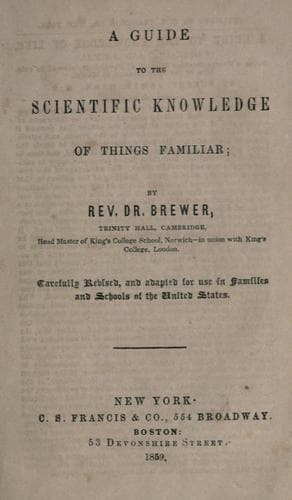
A Guide to the Scientific Knowledge of Things FamiliarBrewer, Ebenezer Cobham
Science
A Guide to the Scientific Knowledge of Things Familiar
Brewer, Ebenezer Cobham
Science -- Juvenile literature
Q. _Why is not the END of a long wick BURNT OFF, as it hangs over the
flames?_
A. Because the length of the wick so diminishes _the heat of the flame_,
that it is not _hot_ enough to burn it off.
Q. _Why do PALMER'S METALLIC WICKS never need SNUFFING?_
A. The wick is divided into two parts, each of which _bends outward_ to
the outside of the flame; where the _end is intensely heated_, and
_separated_ from the wick by the current of air up the candle.
Q. _Why do common CANDLES require to be SNUFFED?_
A. Because the heat of the flame is _not sufficient to consume the
wick_; and the _longer_ the wick grows, the _less heat_ the flame
produces.
Q. _Why do WAX CANDLES NEVER need SNUFFING?_
A. The wick of _wax_ candles is made _of very fine thread_, which the
heat of the flame is sufficient to consume: but the wick of _tallow_
candles is made _of coarse cotton_, which is too substantial to be
consumed by the heat of the flame, and must be cut off by _snuffers_.
Q. _Why does a PIN, stuck in a RUSH-LIGHT, EXTINGUISH it?_
A. Because a _pin_ (being a good conductor), _carries away the heat of
the flame from the wick_, and prevents the combustion of the tallow.
Q. _What is the SMOKE of a CANDLE?_
A. Solid particles of carbon separated from the wick and tallow, but not
consumed.
Q. _Why are SOME particles consumed and not OTHERS?_
A. The _combustion of the carbon_ depends upon its _combining with the
oxygen of the air_: but as the outer surface of the flame _prevents the
access of air to the interior parts_, therefore much of the carbon of
those parts passes off in smoke.
Q. _Why do LAMPS SMOKE?_
A. Either because the _wick is cut unevenly_, or else because _it is
turned up too high_.
Q. _Why does a LAMP SMOKE when the WICK is cut UNEVENLY?_
A. 1st--Because the _points of the jagged edge_ (being very easily
separated from the wick,) _load the flame with more carbon than it can
consume_: and
2ndly--As the heat of the flame is _greatly diminished by these bits of
wick_, it is unable to consume _even the usual quantity of smoke_.
Q. _Why does a LAMP SMOKE when the WICK is turned up too HIGH?_
A. Because more carbon is separated from the wick _than can be consumed
by the flame_.
Q. _Why do not "Argand burners" smoke?_
A. Because a current of air passes through the _middle of the flame_;
and therefore the carbon of the _interior_ is consumed, as well as that
_in the outer coating of the flame_.
Q. _Why does a LAMP-GLASS DIMINISH the SMOKE of a lamp?_
A. Because it both _concentrates and reflects the heat of the flame_; in
consequence of which, the heat is so greatly increased, _that very
little carbon escapes unconsumed_.
CHAPTER VI.
ANIMAL HEAT.
Q. _What is the cause of ANIMAL HEAT?_
A. Animal heat is produced _by the combustion of hydrogen and carbon_ in
the capillary veins.
Q. _What are CAPILLARY VEINS?_
Public-domain text, read in full here on John Shaqi.
Reviews
Reviews
No reviews yet
Be the first to share your thoughts on this work.
Join the Discussion
Join the discussion
Sign in to leave a comment or review.
Sign InorCreate an account