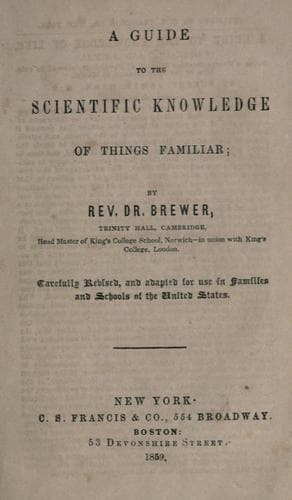
A Guide to the Scientific Knowledge of Things Familiar — John Shaqi
A Guide to the Scientific Knowledge of Things FamiliarBrewer, Ebenezer Cobham
Science
A Guide to the Scientific Knowledge of Things Familiar
Brewer, Ebenezer Cobham
Science -- Juvenile literature
Q. _Why do SPARKS of fire start (with a crackling noise) from pieces of
WOOD laid upon a FIRE?_
A. The _air_ in the wood (expanded by the heat), _forces its way through
the pores of the log_; and carries along with it the _covering of the
pore_, which resisted its passage.
Q. _What is meant by the "PORES of the WOOD?"_
A. Very small _holes in the wood_, through which the _sap_ circulates.
Q. _What are the SPARKS OF FIRE, which burst from the WOOD?_
A. Very small pieces of wood _red hot_, separated from the log by the
_force of the air_, as it bursts from its confinement.
Q. _Why does DEAL make more snapping than any OTHER WOOD?_
A. The pores of deal are _very large_, and contain much _more air_ than
wood of a _closer grain_.
Q. _Why does DRY WOOD make more SNAPPING than GREEN WOOD?_
A. In _green wood_ the pores are filled with _sap_, and therefore
contain _very little air_; but in _dry_ wood the sap is _dried up_, and
the pores are filled with _air_ instead.
Q. _Why does DRY wood BURN more easily than GREEN or wet wood?_
A. Because the pores of dry wood are _filled with air_, which supports
combustion; but the pores of green or wet wood are filled with _vapour_,
which extinguishes flame.
Q. _Why does VAPOUR EXTINGUISH FLAME?_
1st--Because the coat of water (which wraps the fuel round) prevents
the _oxygen_ of the air from getting to the _fuel_, to form into
_carbonic acid gas_: and
2ndly--Heat is perpetually carried off, by the formation of the sap or
water _into steam_.
(Carbonic acid gas is a compound of carbon and oxygen. The solid part of
the fuel is _carbon_, and one of the gases of the air is oxygen.)
Q. _What has CARBONIC ACID GAS to do with COMBUSTION?_
A. Combustion is produced by the _chemical action_ which takes place,
while the _carbon_ of fuel unites with the _oxygen_ of air, and forms
"_carbonic acid gas_." (See p. 36.)
Q. _Why do STONES SNAP and fly about, when heated in the FIRE?_
A. The air in the stones (expanded by the heat of the fire), _meets with
great resistance_ from the close texture of the stone; and, therefore,
_bursts forth with great violence_, tearing the stone to atoms, and
forcing the fragments into the room.
Q. _Must not AIR be very STRONG, to shatter into atoms a hard stone?_
A. Yes. All the dreadful effects of _gunpowder_ are merely the results
of the _sudden expansion of air_.
Q. _When bottled ALE and PORTER is set before a FIRE, why is the CORK
FORCED OUT sometimes?_
A. If the bottle be _not quite full_, there will be _air_ between the
liquor and the cork; this _air_ (expanded by the heat of the fire)
_forces out the cork_.
Q. _Why does ALE or PORTER FROTH more, after it has been set before the
fire?_
A. The _froth_ of ale or porter _depends upon the pressure_ to which it
is subjected; and as the air (between the liquor and the cork) is
_expanded_ by the heat, _it presses against the liquor_, and increases
the quantity of froth.
Public-domain text, read in full here on John Shaqi.
Reviews
Reviews
No reviews yet
Be the first to share your thoughts on this work.
Join the Discussion
Join the discussion
Sign in to leave a comment or review.
Sign InorCreate an account