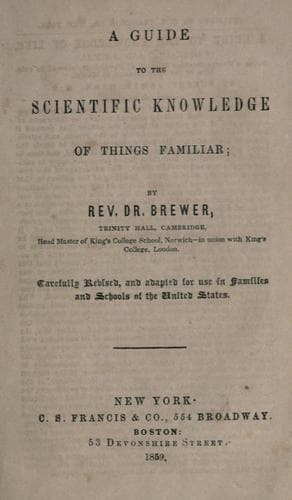
A Guide to the Scientific Knowledge of Things FamiliarBrewer, Ebenezer Cobham
Science
A Guide to the Scientific Knowledge of Things Familiar
Brewer, Ebenezer Cobham
Science -- Juvenile literature
Q. _Why is the FROTH of ale and porter INCREASED by PRESSURE?_
A. Because the liquor absorbs _carbonic acid_ so long as it is under
_pressure_; and the moment that the pressure is _removed_, the carbonic
acid _escapes_ in foam or froth.
Q. _When a boy makes a BALLOON, and sets fire to the cotton or sponge
(which has been steeped in spirits of wine), why is the balloon
INFLATED, or blown out?_
A. The _air_ inside the balloon is _expanded by the flame_, till the
whole balloon is _blown out_ without a crumple.
Q. _Why does the BALLOON RISE, after it has been inflated by the
expanded air?_
A. The same quantity of air is expanded _to three or four times its
original volume_; and is made so much _lighter than common air_, that
even when all the paper, wire, and cotton are added, it is still lighter
bulk for bulk.
Q. _What is meant by being lighter "bulk for bulk?"_
A. If the balloon be 3 square feet in size, it is _lighter_ (when
inflated) than 3 square feet of _common air_, and therefore _floats
through it_; as a cork (at the bottom of a tub of water) would rise to
the surface.
Q. _Why does SMOKE RUSH UP a CHIMNEY?_
A. The heat of the fire _expands the air in the chimney_; and (being
thus made _lighter_ than the air around), it _rises up the chimney_, and
carries the smoke in its current.
Q. _Why has a LONG CHIMNEY a greater DRAUGHT than a short one?_
A. Because air rises faster and faster the _higher it ascends_ in a
chimney flue; the same as a stone falls faster and faster the _nearer
it approaches to the ground_.
Q. _Why will a LONG chimney SMOKE, unless the FIRE be pretty FIERCE?_
A. If the fire be not pretty fierce, its heat will not be sufficient to
_rarefy all the air in the chimney_; and then the chimney will _smoke_.
Q. _Why will the chimney smoke, if the fire be not BIG enough to heat
ALL the air in the CHIMNEY FLUE?_
A. Because the _cold air_ (condensed in the upper part of the flue),
_will sink from its own weight_, and sweep the ascending smoke _back
with it_ into the room.
Q. _What is the use of a COWL upon a chimney-pot?_
A. The cowl acts as a _screen against the wind_, to prevent it from
blowing into the chimney.
Q. _What HARM would the WIND do, if it were to BLOW into a CHIMNEY?_
A. 1st--It would prevent the smoke from getting out: and
2ndly--The _cold air_ (introduced into the chimney by the wind) _would
fall down the flue_, and drive the smoke with it _back into the room_.
Q. _Why does a SMOKE-JACK turn round in a chimney?_
A. The current of hot air up the chimney, striking against the _oblique
vanes of the smoke-jack_, drives them round and round; in the same way
as the sails of a _wind-mill_ are driven round by the _wind_.
Q. _Why are some things SOLID, others LIQUID, and others GASEOUS?_
A. As _heat_ enters any substance, _it drives its particles further
asunder_; and a _solid_ (like _ice_) becomes a _liquid_; and a _liquid_
(like _water_) becomes a _gas_.
Public-domain text, read in full here on John Shaqi.
Reviews
Reviews
No reviews yet
Be the first to share your thoughts on this work.
Join the Discussion
Join the discussion
Sign in to leave a comment or review.
Sign InorCreate an account