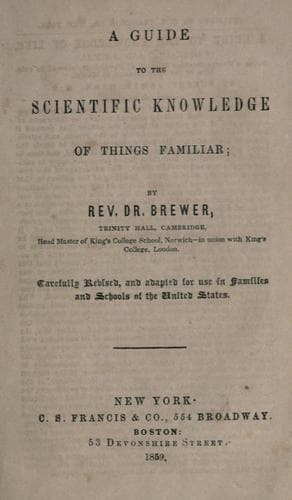
A Guide to the Scientific Knowledge of Things FamiliarBrewer, Ebenezer Cobham
Science
A Guide to the Scientific Knowledge of Things Familiar
Brewer, Ebenezer Cobham
Science -- Juvenile literature
A. The moment the water in the larger pot is _boiling hot_ (or 212°),
_steam is formed_, and _carries off some of its heat_; therefore, 212
_degs._ of heat can never _pass through it_, to raise the _inner_
vessel to the _same heat_.
Q. _Why do SUGAR, SALT, &c. RETARD the process of BOILING?_
A. Because they have a tendency to _fix_ water by chemical attraction;
and therefore retard its _conversion into steam_.
Q. _If you want water to boil, without COMING IN CONTACT with the
SAUCEPAN, what plan must you adopt?_
A. _Immerse the pot_ (containing the water you want to boil) in a
saucepan containing _strong brine_, or sugar.
Q. _Why would the INNER vessel boil, if the OUTER vessel contained
strong BRINE?_
A. Though _water_ boils at 212 _degs._ of heat, yet _brine_ will not
boil till raised to 218 or 220 _degs._ Therefore, 212 _degs._ of
heat may easily pass through brine _to raise the vessel immersed in it
to boiling heat_, before any of it is _carried off by steam_.
Q. _Why will brine impart to another vessel MORE than 212°, and water
NOT SO MUCH?_
A. Because both liquids will _impart heat_ till they _boil_, and then
_they can impart heat no longer_.
Q. _Why can they impart no extra heat after they boil?_
A. Because all _extra_ heat is spent _in making steam_. Hence water will
_not_ boil a vessel of water immersed in it, because it cannot impart to
it 212 _degs._ of heat: but _brine_ will, because it can impart _more
than_ 212 _degs. of heat_, without being converted itself into steam.
Ether boils at 104 _degs._
Alcohol - - 173-1/2 "
Water - - 212 "
Water with one-fifth salt 219 "
Syrup boils at 221 "
Oil of turpentine, 304 "
Sulphuric acid 472 "
Linseed oil - 640 "
&c. &c.
Any liquid which boils at a _lower_ degree can be made to boil if
immersed in a liquid which boils at a higher degree. Thus a _cup of
ether_ can be made to boil in a saucepan of _water_. A _cup of water_ in
a saucepan of _brine or syrup_. But a _cup of water_ will _not_ boil if
immersed in _ether_; nor a _cup of syrup_ in _water_.
Q. _Why are CLOUDS HIGHER on a FINE DAY?_
A. 1st--Because the _air_ (expanded by heat) _drives them higher up_:
and
2ndly--The _clouds themselves are lighter_, and therefore _more
buoyant_.
Q. _Why are the CLOUDS LIGHTER on a FINE DAY?_
A. Because their mists are either _absorbed by the dry air_, or
_vapourized_ by the hot sun.
Q. _Why is a CUP PUT topsy-turvy into a FRUIT-PIE?_
A. Its principal use is to _hold the crust up_, and _prevent it from
sinking_, when the cooked fruit gives away under it.
Q. _Does not the cup PREVENT the FRUIT of the pie from BOILING OVER?_
A. No, by no means; it would rather tend to _make it boil over_, than
otherwise.
Q. _Why would the cup tend rather to MAKE the FRUIT BOIL OVER?_
Public-domain text, read in full here on John Shaqi.
Reviews
Reviews
No reviews yet
Be the first to share your thoughts on this work.
Join the Discussion
Join the discussion
Sign in to leave a comment or review.
Sign InorCreate an account