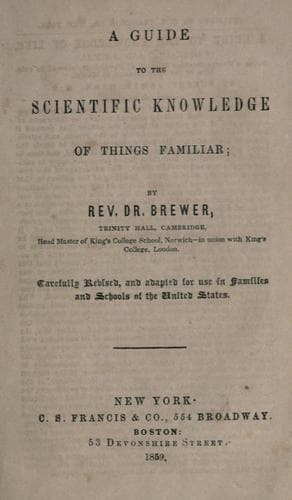
A Guide to the Scientific Knowledge of Things FamiliarBrewer, Ebenezer Cobham
Science
A Guide to the Scientific Knowledge of Things Familiar
Brewer, Ebenezer Cobham
Science -- Juvenile literature
Q. _Why is a pot, which is full to OVERFLOWING (while the water is
boiling HOT), NOTHING LIKE FULL, when it has been taken off the fire for
a short time?_
A. When the water was _swelled by boiling heat_, it filled the pot even
to overflowing; but as soon as the water is _condensed by cold_, it
_contracts_ again, and occupies a much less space.
Q. _Why does the water of a KETTLE run out of the SPOUT when it BOILS?_
A. Because the steam cannot escape _so fast as it is formed_, and (being
_confined in the kettle_) _presses on the water with great power_, and
forces it out of the spout.
Q. _How can the PRESSURE of STEAM on the SURFACE of the water, FORCE the
water through the KETTLE-SPOUT?_
A. In the same manner as _the pressure of air_ on the _mercury of a
barometer_, forces the _quicksilver up the glass tube_.
Q. _What causes the RATTLING NOISE so often made by the LID of a
saucepan or boiler?_
A. The steam (seeking to escape) _forces up the lid_ of the boiler, and
the _weight_ of the lid causes it to _fall back again_: this being done
_frequently_, produces a rattling noise.
Q. _If the steam COULD NOT LIFT UP THE LID of the boiler, how would it
escape?_
A. If the lid fitted so tightly, that the steam could not raise it up,
the boiler would _burst into fragments_, and the consequences might be
fatal.
Q. _When steam pours out from the spout of a kettle, the STREAM begins
apparently HALF AN INCH off the SPOUT; why does it not begin CLOSE to
the spout?_
A. Steam is really _invisible_; and the half-inch (between the spout and
the "_stream of mist_") is the _real steam_, before it has been
condensed by air.
Q. _Why is not ALL the stream INVISIBLE, as well as that half-inch?_
A. As the steam _comes in contact with the colder air_, the invisible
particles (being _condensed_), roll one into another, and look like a
thick mist.
Q. _What BECOMES OF the STEAM? for it soon vanishes._
A. After it is condensed into mist, it is _dissolved by the air_, and
dispersed abroad as _invisible vapour_.
Q. _And what BECOMES of the INVISIBLE VAPOUR?_
A. Being _lighter than air_, it _ascends_ to the upper regions, where
(being again _condensed_) it contributes to form _clouds_.
Q. _Why does a METAL SPOON, left in a saucepan, RETARD the process of
BOILING?_
A. The metal spoon (being an excellent _conductor_) _carries off the
heat from the water_; and (as heat is carried off by the spoon) the
water takes a longer time to boil.
Q. _Why will a POT (filled with water) NEVER BOIL, when immersed in
ANOTHER vessel full of water also?_
A. Because water can _never be heated above the boiling point_: all the
heat absorbed by the water after it _boils_, is employed in _converting
the water into steam_.
Q. _How does the conversion of water into steam prevent the INNER POT
from BOILING?_
Public-domain text, read in full here on John Shaqi.
Reviews
Reviews
No reviews yet
Be the first to share your thoughts on this work.
Join the Discussion
Join the discussion
Sign in to leave a comment or review.
Sign InorCreate an account