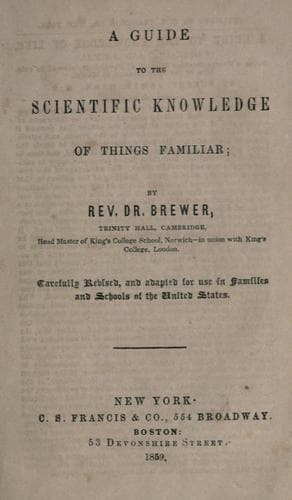
A Guide to the Scientific Knowledge of Things FamiliarBrewer, Ebenezer Cobham
Science
A Guide to the Scientific Knowledge of Things Familiar
Brewer, Ebenezer Cobham
Science -- Juvenile literature
Q. _Why does not WOOD MELT, like metal?_
A. Because the heat of the fire _decomposes_ the wood into _gas, smoke,
and ashes_; and the different parts _separate from each other_.
Q. _What is meant by VAPORIZATION?_
A. The _conversion of liquid into vapour_; as water is converted into
vapour by the heat of the sun.
Q. _What are CLOUDS?_
A. Moisture _evaporated from the earth_, and collected in the upper
regions of the air.
Q. _What is the difference between a FOG and a CLOUD?_
A. Clouds and fogs differ only in one respect. _Clouds are elevated
above our heads_: but _fogs come in contact with the surface of the
earth_.
Q. _If CLOUDS are WATER, why do they FLOAT on the air?_
A. 1st--The vapour of clouds is composed of _very minute bubbles_
(called ves'cicles), which float like _soap bubbles_: and
2ndly--Warm air (between the bubbles) _keeps them apart_, and makes the
mass _lighter_; and the currents of air (which constantly ascend from
the warm earth) _buoy them up_.
Q. _Why does VAPOUR sometimes form into CLOUDS, and sometimes rest upon
the earth as MIST or FOG?_
A. When the _surface of the earth_ is _warmer than the air_, the vapour
of the earth (being condensed by the chill air) becomes _mist or fog_.
But when the _air_ is _warmer than the earth_, the vapour _rises through
the air_, and becomes cloud.
Q. _Are ALL clouds ALIKE?_
A. No. They vary greatly in _density, height, and colour_.
Q. _What is the chief CAUSE of fog and CLOUDS?_
A. The changes of the wind.
Q. _How can the CHANGES of the WIND affect the CLOUDS?_
A. If a _cold current of wind_ blows suddenly over any region, it
_condenses_ the invisible vapour of the air into _cloud or rain_: but if
a _warm current of wind_, blows over any region, it _disperses_ the
clouds, by _absorbing their vapour_.
Q. _What_ COUNTRIES _are the_ MOST CLOUDY?
A. Those where the winds are _most variable_, as Britain.
Q. _What COUNTRIES are the LEAST cloudy?_
A. Those where the winds are _not variable_, as Egypt.
Q. _What DISTANCE are the CLOUDS from the EARTH?_
A. Some _thin light clouds_ are elevated above the highest mountain-top;
some _heavy_ ones touch the steeples, trees, and even the earth: but
the _average_ height is between _one and two miles_.
(Streaky curling clouds, _like hair_, are often five or six miles high.)
Q. _What CLOUDS are the LOWEST?_
A. Those that are _most highly electrified_: lightning clouds are rarely
more than about 700 yards above the ground; and very often actually
_touch the earth with one of their edges_.
Q. _What is the THICKNESS of the CLOUDS?_
A. Some clouds are 20 _square miles in surface_, and above _a mile in
thickness_; while others are only a _few yards or inches_.
Q. _How can persons ascertain the thickness of a cloud?_
Public-domain text, read in full here on John Shaqi.
Reviews
Reviews
No reviews yet
Be the first to share your thoughts on this work.
Join the Discussion
Join the discussion
Sign in to leave a comment or review.
Sign InorCreate an account