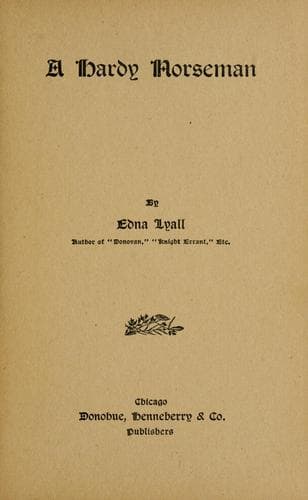
British -- Norway -- Fiction; Conduct of life -- Fiction; Norwegians -- England -- Fiction
His heart was so utterly dead that he could not even think of his home;
neither his father nor Sigrid rose before him as he looked down that
long, dreary vista of life that lay beyond. He could only see that
Blanche was no longer his; that the Blanche he had loved and believed in
had never really existed; that he had been utterly deceived, cheated,
defrauded; and that something had been taken from him which could never
return.
“I will not live a day longer,” he said to himself; “not an hour
longer.” And in the relief of having some attainable thing to desire
ardently, were it only death and annihilation, he quickened his pace and
felt a sort of renewal of energy and life within him, urging him on,
holding before him the one aim which he thought was worth pursuing. He
would end it all quickly, he would not linger on, weakly bemoaning his
fate, or railing at life for having failed him and disappointed his
hopes; he would just put an end to everything without more ado. As to
arguing with himself about the right or wrong of the matter, such a
notion never occurred to him, he just walked blindly on, certain that
some opportunity would present itself, buoyed up by an unreasoning hope
that death would bring him relief.
By this time he had reached Hyde Park, and a vague memory came back to
him; he remembered that, as he drove to Lancaster Gate, that afternoon,
he had crossed a bridge. There was water over there. It should be that
way. And he walked on more rapidly than before, still with an almost
dazzling perception of all the trifling little details, the color of the
dry, dusty road, the green of the turf, the dresses of those who passed
by him, the sound of their voices, the strange incongruity of their
perfectly unconcerned, contented faces. He would get away from all
this—would wait till it was dusk, when he could steal down unnoticed to
the water. Buoyed up by this last hope of relief, he walked along the
north shore of the Serpentine, passed the Receiving House of the Royal
Humane Society, with an unconcerned thought that his lifeless body would
probably be taken there, passed the boat-house with a fervent hope that
no one there would try a rescue, and at length, finding a seat under a
tree close to the water’s edge, sat down to wait for the darkness. It
need not be for long, for already the sun was setting, and over toward
the west he could see that behind the glowing orange and russet of the
autumn trees was a background of crimson sky. The pretty little wooded
island and the round green boat-house on the shore stood out in strong
relief; swans and ducks swam about contentedly; on the further bank was
a dark fringe of trees; away to the left the three arches of a
gray-stone bridge. In the evening light it made a fair picture, but the
beauty of it seemed only to harden him, for it reminded him of past
happiness; he turned with sore-hearted relief to the nearer view of the
Serpentine gleaming coldly as its waters washed the shore, and to the
Public-domain text, read in full here on John Shaqi.
Reviews
Reviews
No reviews yet
Be the first to share your thoughts on this work.
Join the Discussion
Join the discussion
Sign in to leave a comment or review.
Sign InorCreate an account