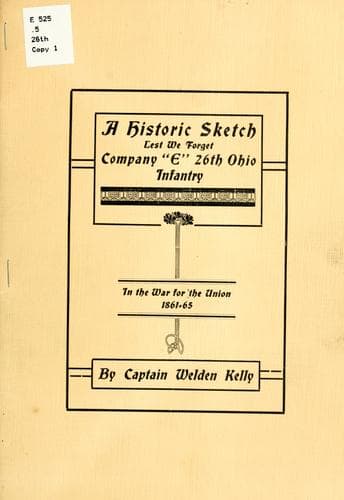
A Historic Sketch, Lest We Forget Company "E," 26th Ohio Infantry in the War for the Union, 1861-65Kelly, Walden
History
A Historic Sketch, Lest We Forget Company "E," 26th Ohio Infantry in the War for the Union, 1861-65
Kelly, Walden
United States -- History -- Civil War, 1861-1865 -- Regimental histories; United States. Army. Ohio Infantry Regiment, 26th (1861-1865)
present, and as a rule, if you follow the trail of blood, you are keeping
close to the fighting line.
The veterans of that old division, whose well-tried courage shone forth in
historic grandeur, it is not overpraise to say were practically
panic-proof. Opdyke was in the direct line of retreat, and on the same
reasons given by Cox and others for the break in the line at the Carter
House, he (Opdyke) with no line of works to protect them would certainly
have been "carried away" if the flight of Lane and Conrad had continued to
the river. The men of the 26th were called from the lines and we crossed
the river before midnight and continued our march, arriving at Nashville
December 1st, near noon, where we made coffee and lay down to rest for
the first time since the morning of November 29th. In the evening company
E was called to tear down some buildings in front of our established line
and to build works during the night. We remained at this line until the
battle of Nashville, December 15th and 16th. December 9th Captain Wm.
Clark was promoted to Lieutenant Colonel, First Lieutenant Phillips M.
Ogan to Captain and Sergeant Walden Kelly to First Lieutenant. The first
day of the battle, the 4th corps, leaving a detail to hold the works,
moved to the right, attacked the enemy, driving them from their fortified
position. The 26th Ohio was left in our main line of works, deployed to a
division front or nearly half a mile. Our instructions were to hold them.
We were not engaged the first day. On the morning of the second day's
battle, December 16th, before daylight, we moved to position in the front
line of the brigade and at daylight moved toward the Brentwood Hills,
driving the enemy's outposts and establishing our lines under easy Enfield
rifle range of their fortified line. Under a heavy artillery and infantry
fire we held position until about 3 p. m., when we were instructed to
prepare ten rounds for rapid firing, at a given signal to commence and at
a second signal, to be given as we exhausted the ninth round, we were to
charge with loaded guns and capture the works on our front. These
instructions were literally carried out, a heavy per cent of the enemy
being captured in their works. We pursued rapidly until dusk. Early in the
morning of the 17th we were in pursuit, the 4th corps in the lead on the
direct line of Hood's retreat. Thus in midwinter, following as rapidly as
possible, the bridges were all destroyed, and flooded streams delayed the
pursuit, which was continued until January 1, 1865. The broken and
disorganized army of Hood's crossed the Tennessee River at Florence, Ala.
The latter part of the campaign was done by us on short rations; three
days to last five were the orders. Our line of march was changed to
Huntsville, Ala., where we arrived January 7, 1865, and remained enjoying
a well-earned season of rest until March 15. Soon after arriving Captain
Ogan rejoined his company and Lieutenant Kelly was temporarily placed in
Public-domain text, read in full here on John Shaqi.
Reviews
Reviews
No reviews yet
Be the first to share your thoughts on this work.
Join the Discussion
Join the discussion
Sign in to leave a comment or review.
Sign InorCreate an account