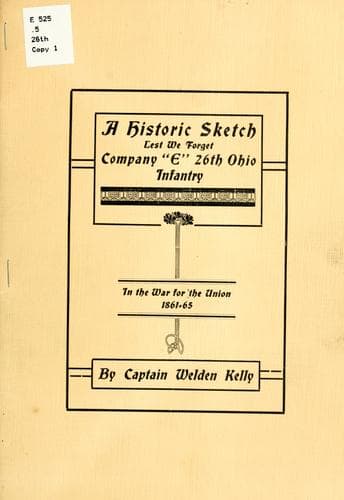
A Historic Sketch, Lest We Forget Company "E," 26th Ohio Infantry in the War for the Union, 1861-65Kelly, Walden
History
A Historic Sketch, Lest We Forget Company "E," 26th Ohio Infantry in the War for the Union, 1861-65
Kelly, Walden
United States -- History -- Civil War, 1861-1865 -- Regimental histories; United States. Army. Ohio Infantry Regiment, 26th (1861-1865)
command of company F. This proved to be permanent. On February 28th he was
commissioned captain and assigned to said company after having served
three years and over eight months in company E, and, as it proved, after
all our fighting was over. In March we (the 4th army corps), moved to East
Tennessee by rail via Chattanooga and Knoxville to Bulls Gap, thence
marched repairing and rebuilding the railroad northeast toward Richmond,
Va. While at this work, near Greenville, Tenn., we received the news of
Lee's surrender. That night was spent hilariously cheering and singing
that old familiar piece, "Go Tell Aunt Rhoda the Old Gray Goose Is Dead."
The following morning I doubt if there was enough ammunition in the
cartridge boxes of the men in our division to have made a respectable
skirmish. Soon afterward Johnston surrendered to Sherman and the 4th corps
was ordered by rail to Nashville, where we expected to be mustered out.
May 9th the corps passed in review before General Thomas and received his
congratulatory order on the 10th. About the 1st of June it became the
talk of the camp that our corps would probably be sent to the Mexican
frontier on account of the Maximilian government which foreign powers were
trying to establish there. Strong protests were made by both officers and
men, feeling that we had fulfilled the terms of our enlistment, "three
years or during the war," but to no avail. June 16th the command started.
Just before starting all who had less than ninety day's to serve were
mustered out. The 97th Ohio infantry of our brigade came under this order.
Fifty-six of their men, who had more than the specified time yet to serve,
were transferred to the 26th, company E receiving her share of them. The
command moved by rail to Johnsonville, Tenn., thence, by steamboats down
the Tennessee, Ohio and Mississippi Rivers to New Orleans, La., by ocean
steamers to the Matagorda Bay, landing at Indianola, since destroyed by a
storm similar to the one a few years ago at Galveston. We marched about
thirty-five miles and camped on the Plasadore, about July 20th. Here we
remained. Nothing especially interesting or eventful worth relating took
place--no drill, except dress parade. Guard and fatigue duty was reduced
to the minimum until mustered out October 21. We started on the home trip
the 24th. On account of storms and an unsafe vessel we ran into the harbor
at Galveston and remained four days, were transferred to a safer vessel
and arrived at New Orleans November 4th. We came up the Mississippi to
Cairo on the steamer Ruth, the largest vessel then plying the river; by
rail (freight cars) via Matoon, Ill., Terra Haute and Indianapolis, Ind.
From there we took passenger coaches to Columbus, Ohio. The enlisted men
received their pay and discharges in the same barracks that we had built
when the regiment organized in June, 1861. The commissioned officers were
held one day later to turn over the official records and make final
Public-domain text, read in full here on John Shaqi.
Reviews
Reviews
No reviews yet
Be the first to share your thoughts on this work.
Join the Discussion
Join the discussion
Sign in to leave a comment or review.
Sign InorCreate an account