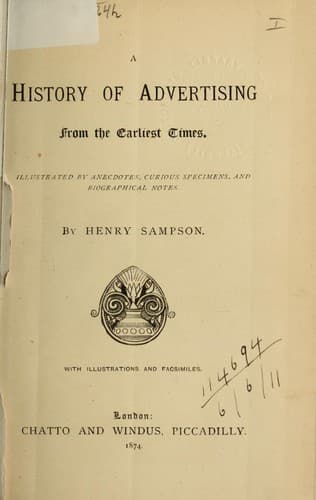
A History of Advertising from the Earliest Times.Sampson, Henry
History
A History of Advertising from the Earliest Times.
Sampson, Henry
Advertising -- History
Let us commence here with the year 1674, a period when the rages and
fashions, the plague and fire, and the many things treated of by means
of advertisements in the preceding chapter, had plunged England into a
most unhappy condition. The reaction from Puritanism was great, but the
reaction from royalty and extravagance threatened to be still greater.
Speaking of the state of affairs about this time, a famous historian,
who has paid particular attention to the latter part of the seventeenth
century, says: “A few months after the termination of hostilities on the
Continent, came a great crisis in English politics. Towards such a
crisis things had been tending during eighteen years. The whole stock of
popularity, great as it was, with which the King had commenced his
administration, had long been expended. To loyal enthusiasm had
succeeded profound disaffection. The public mind had now measured back
again the space over which it had passed between 1640 and 1660, and was
once more in the state in which it had been when the Long Parliament
met. The prevailing discontent was compounded of many feelings. One of
these was wounded national pride. That generation had seen England,
during a few years, allied on equal terms with France, victorious over
Holland and Spain, the mistress of the sea, the terror of Rome, the head
of the Protestant interest. Her resources had not diminished; and it
might have been expected that she would have been, at least, as highly
considered in Europe under a legitimate king, strong in the affection
and willing obedience of his subjects, as she had been under an usurper
whose utmost vigilance and energy were required to keep down a mutinous
people. Yet she had, in consequence of the imbecility and meanness of
her rulers, sunk so low, that any German or Italian principality which
brought five thousand men into the field, was a more important member of
the commonwealth of nations. With the sense of national humiliation was
mingled anxiety for civil liberty. Rumours, indistinct indeed, but
perhaps the more alarming by reason of their indistinctness, imputed to
the Court a deliberate design against all the constitutional rights of
Englishmen. It had even been whispered that this design was to be
carried into effect by the intervention of foreign arms. The thought of
such intervention made the blood, even of the Cavaliers, boil in their
veins. Some who had always professed the doctrine of non-resistance in
its full extent, were now heard to mutter that there was one limitation
to that doctrine. If a foreign force were brought over to coerce the
nation, they would not answer for their own patience. But neither
national pride nor anxiety for public liberty had so great an influence
on the popular mind as hatred of the Roman Catholic religion. That
hatred had become one of the ruling passions of the community, and was
as strong in the ignorant and profane as in those who were Protestants
from conviction.
Public-domain text, read in full here on John Shaqi.
Reviews
Reviews
No reviews yet
Be the first to share your thoughts on this work.
Elsewhere in the archive
Join the Discussion
Join the discussion
Sign in to leave a comment or review.
Sign InorCreate an account