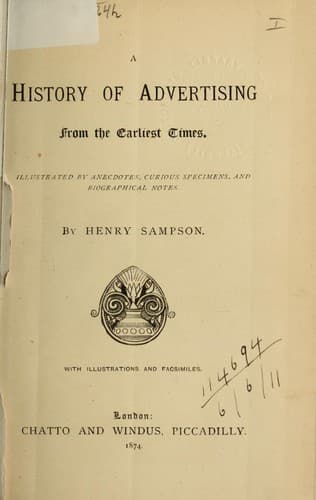
A History of Advertising from the Earliest Times.Sampson, Henry
History
A History of Advertising from the Earliest Times.
Sampson, Henry
Advertising -- History
By this means the newspaper and the private letter were combined, and it
is easy to understand the delight with which a gossiping and
scandalising effusion, possessed of the additional advantage of being
written on this kind of paper, was received at a lonely country house,
by people pining after the gaieties of metropolitan life. The newsletter
proper was a very ancient article of intercommunication, and it seems
strange that it should have flourished long after the introduction of
newspapers, which it certainly did. This may be accounted for by the
fact, that during the time of the Rebellion it was much safer to write
than to print any news which was intended to be read at a distance, or
which had any political significance. It has been remarked that many of
these newsletters “were written by strong partisans, and contained
information which it was neither desirable nor safe that their opponents
should see. They were passed on from hand to hand in secret, and often
indorsed by each successive reader. We are told that the Cavaliers, when
taken prisoners, have been known to eat their newsletters; and some of
Prince Rupert’s, which had been intercepted, are still in existence, and
bear dark red stains which testify to the desperate manner in which they
were defended. It is pretty certain, however, that as a profession
newsletter writing began to decline after the Revolution, though we find
the editor of the _Evening Post_, as late as the year 1709, reminding
its readers that ‘there must be three or four pounds a year paid for
written news.’ At the same time, the public journals, it is clear, had
not performed that part of their office which was really more acceptable
to the country reader than any other--the retailing the political and
social chit-chat of the day. We have only to look into the public papers
to convince ourselves how woefully they fell short in a department which
must have been the staple of the newswriter.” It would seem, therefore,
that this effort of Mr Salusbury was to combine the old letter with the
modern paper, and thus at once oblige his customers and save a
time-honoured institution from passing away. It would seem as if he
succeeded, for there are in the British Museum many specimens of papers,
half print half manuscript; and as most of the written portions are of
an extremely treasonable nature, possibly the opportunity to send the
kind of news which suited them best, and thus combine friendship and
duty, was eagerly seized by the Jacobites. But how singular after all it
seems for an editor to invite his subscribers to write their own news
upon their own newspapers!
Public-domain text, read in full here on John Shaqi.
Reviews
Reviews
No reviews yet
Be the first to share your thoughts on this work.
Elsewhere in the archive
Join the Discussion
Join the discussion
Sign in to leave a comment or review.
Sign InorCreate an account