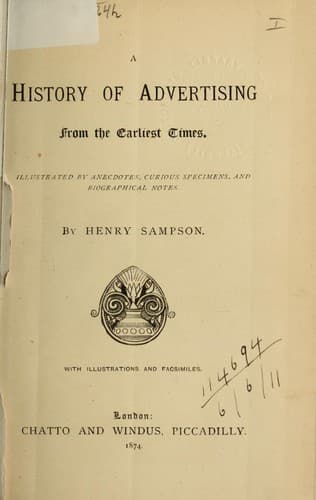
A History of Advertising from the Earliest Times.Sampson, Henry
History
A History of Advertising from the Earliest Times.
Sampson, Henry
Advertising -- History
It is now apparent that advertising has become recognised as a means of
communication not only for the conveniencies of trade, but for
political, lovemaking, fortune-hunting, swindling, and the thousand and
one other purposes which are always ready to assert themselves in a
large community. It is also evident that as years have progressed,
advertising has become more and more necessary to certain trades, the
principals in which a comparatively short time before would have scorned
the idea of ventilating their wares through the columns of the public
press. So it is therefore as well to notice the rates which were charged
by some of the papers. This was before the duty was placed upon
advertisements, when the arrangement was simply between one who wished a
notice inserted in a paper, and another who possessed the power of
making such insertion. It is of course impossible to tell what the rates
were on all papers, but as some had notices of price per advertisement
stated at foot, a fair estimate may be made. The first advertisements
were so few that no notice was called for, and it was not until every
newspaper looked forward to the possession of more or less that the plan
of stating charges became common. About the period of which we are now
writing, long advertisements were unknown; they generally averaged about
eight lines of narrow measure, and were paid for at about a shilling
each, with fluctuations similar in degree to those of the leading
papers of the present day. Various rules obtained upon various papers.
One journal, the “_Jockey’s Intelligencer_, or Weekly Advertisements for
Horses and Second-Hand Coaches to be Bought and Sold,” which appeared
towards the end of the seventeenth century, charged “a shilling for a
horse or coach for notification, and sixpence for renewing.” Still
later, the _County Gentleman’s Courant_ seems to have been the first
paper to charge by the line, and in one of its numbers appears the
following rather non-sequitous statement: “Seeing promotion of trade is
a matter which ought to be encouraged, the price of advertisements is
advanced to twopence per line.” Very likely many agreed with the writer,
who seems to have had a follower several years afterwards--a corn
dealer, who during a great dearth stuck up the following notification:
“On account of the great distress in this town, the price of flour will
be raised one shilling per peck.” But neither of these men meant what he
said, though doubtless he thought he did.
The first advertisement with which we open the century is of a
semi-religious character, and betrays a very inquiring disposition on
the part of the writer. Facts of the kind required are, however, too
stubborn to meet with publication at the request of everybody, and if Mr
Keith and other controversialists had been trammelled by them, there is
every probability that the inquiry we now republish would never have
seen the light:--
Public-domain text, read in full here on John Shaqi.
Reviews
Reviews
No reviews yet
Be the first to share your thoughts on this work.
Elsewhere in the archive
Join the Discussion
Join the discussion
Sign in to leave a comment or review.
Sign InorCreate an account