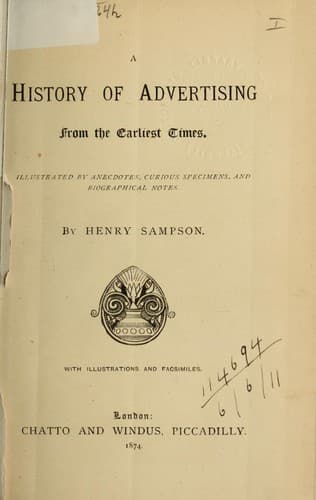
A History of Advertising from the Earliest Times.Sampson, Henry
History
A History of Advertising from the Earliest Times.
Sampson, Henry
Advertising -- History
We should imagine that, unless both coats and gentlemen were more
plentiful, in proportion to the population, in those days than they are
now, the rightful owner, who had probably also been a visitor at the
establishment, went without a garment which, judging by the date, must
have been peculiarly liable to excite cupidity. Nothing noticeable
occurs for a long time, except the growth of raffle advertisements, and
notices of lotteries. These arrangements were called sales, though the
only things sold were most likely the confiding speculators. Everything
possible was during this age put up to be raffled, though, with the
exception of the variety of the items, which included eatables, wearing
apparel, houses, carriages and horses, &c. &c., there is nothing calling
for comment about the style of the notices. In the _Postman_ of July
19-22, 1707, we at last come upon this, which is certainly peculiar from
more than one point of view:--
MR Benjamin Ferrers, Face-painter, the gentleman that can’t neither
speak nor hear, is removed from the Crown and Dagger at Charing Cross
into Chandois Street, next door to the sign of the Three Tuns in
Covent Garden.
This must have been one of the few cases in which physical disability
becomes a recommendation. Yet the process of whitening sepulchres must
after a time have become monotonous to even a deaf and dumb man. We
suppose the highest compliment that could have been paid to his work
was, that the ladies who were subjected to it looked “perfect pictures.”
Just about this time the use of advertisements for the purposes of
deliberate puffery began to be discovered by the general trader, and in
the _Daily Courant_ of March 24, 1707, occurs a notice couched in the
style of pure hyperbole, and emanating from the establishment of G.
Willdey and T. Brandreth, at the sign of the Archimedes and Globe, on
Ludgate Hill, who advertised a microscope which magnified objects more
than two million times, and a concave metal that united the sunbeams so
vigorously that in a minute’s time it melted steel and vitrified the
hardest substance. “Also,” the notice went on to say, “we do protest we
pretend to no impossibilities, and that we scorn to impose on any
gentleman or others, but what we make and sell shall be really good, and
answer the end we propose in our advertisements.” Spectacles by which
objects might be discovered at twenty or thirty miles’ distance,
“modestly speaking,” are also mentioned; “and,” the ingenious opticians
finish off with, “we are now writing a small treatise with the aid of
the learned that gives the reasons why they do so, which will be given
gratis to our customers.” This is an effort which would not have
disgraced the more mature puffers of following ages. But it aroused the
anger and indignation of the former employers of Willdey and Brandreth,
who having duly considered the matter, on April 16 put forth, also in
the _Daily Courant_, an opposition statement, which ultimately led to a
Public-domain text, read in full here on John Shaqi.
Reviews
Reviews
No reviews yet
Be the first to share your thoughts on this work.
Elsewhere in the archive
Join the Discussion
Join the discussion
Sign in to leave a comment or review.
Sign InorCreate an account