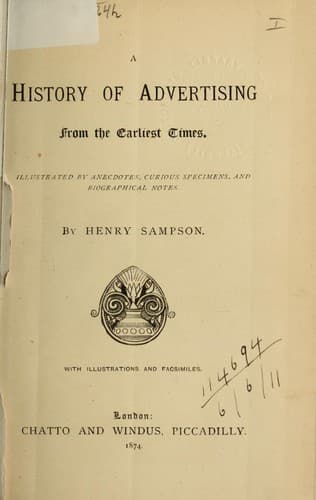
A History of Advertising from the Earliest Times.Sampson, Henry
History
A History of Advertising from the Earliest Times.
Sampson, Henry
Advertising -- History
has made wary, lay out their money on quite a different principle from
that of the casual advertiser. They have learned their lesson, and if
they pay extra for position or insertion, they know that their outlay is
remunerative; whereas, if it were not governed by caution and system, it
would be simply ruinous. In fact, advertising is a most expensive luxury
if not properly regulated, and a most valuable adjunct when coolness and
calculation are brought to bear upon it as accessories.
The heavy duties originally imposed upon newspapers, both on them and
their advertisements, were at first a considerable check to the number
of notices appearing in them. For, in the first place, the high price of
the papers narrowed the limits of their application; and, in the second,
the extra charge on the advertisements made them above the reach of
almost all but those who were themselves possessed of means, or whose
business it was to pander to the unholy and libidinous desires of the
wealthy. This, we fancy, will be extensively proved by a reference to
the following pages; for while it is our endeavour to keep from this
book all really objectionable items, we are desirous that it shall place
before the reader a true picture of the times in which the
advertisements appeared; and we are not to be checked in our duty by any
false delicacy, or turned from the true course by any squeamishness,
which, unfortunately for us in these days, but encourages the vices it
attempts to ignore.
The stamp duty on newspapers was first imposed in 1713, and was one
halfpenny for half a sheet or less, and one penny “if larger than half a
sheet and not exceeding a whole sheet.” This duty was increased a
halfpenny by an Act of Parliament, 30 Geo. II. c. 19; and by another
Act, 16 Geo. III. c. 34, another halfpenny was added to the tax. This
not being considered sufficient, a further addition of a halfpenny was
made (29 Geo. III. c. 50), and in the thirty-seventh year of the same
wise monarch’s reign (c. 90) three-halfpence more was all at once placed
to the debit of newspaper readers, which brought the sum total of the
duty up to fourpence. An Act of 6 & 7 Will. IV. c. 76 reduced this duty
to one penny, with the proviso, however, that when the sheet contained
1550 superficial inches on either side, an extra halfpenny was to be
paid, and when it contained 2295, an extra penny. An additional
halfpenny was also charged on a supplement, which may be regarded, when
the use of supplements in the present day is taken into consideration,
as an indirect tax on advertisements. In 1855, by an Act 18 & 19 Vict.
c. 27, this stamp duty was abolished, and immediately an immense number
of newspapers started into existence, most of which, however, obtained
but a most ephemeral being, and died away, leaving no sign. There are,
however, a large number of good and useful papers still flourishing,
which would never have been published but for the repeal of the
newspaper stamp duty.
Public-domain text, read in full here on John Shaqi.
Reviews
Reviews
No reviews yet
Be the first to share your thoughts on this work.
Join the Discussion
Join the discussion
Sign in to leave a comment or review.
Sign InorCreate an account