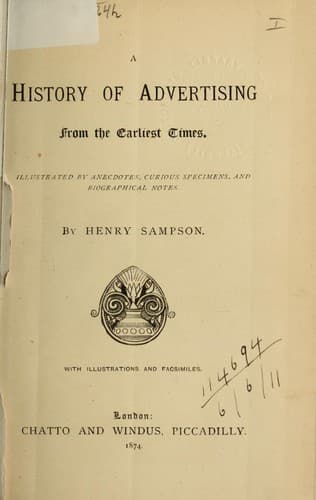
A History of Advertising from the Earliest Times. — John Shaqi
A History of Advertising from the Earliest Times.Sampson, Henry
History
A History of Advertising from the Earliest Times.
Sampson, Henry
Advertising -- History
It is stated by several writers that the earliest English provincial
newspaper is believed to be the _Norwich Postman_, which was published
in 1706 at the price of a penny, and which bore the quaint statement,
that a halfpenny would not be refused. Newspaper proprietors,
publishers, and editors were then evidently, so far as Norwich is
concerned, less strong than they are now in their own conceit, and in
their belief in the press as an organ of great power. This _Postman_ was
followed in 1714 by the _Norwich Courant_ or _Weekly Packet_. York and
Leeds followed in 1720, Manchester in 1730, and Oxford in 1740. It was
not, however, until advertising became an important branch of commercial
speculation that the provincial press began in any way to flourish. Now
the journals published in our largest country towns command extensive
circulations, and are regarded by many advertising agents, whose
opinions are fairly worth taking, as being much more remunerative media
than our best London papers. For certain purposes, and under certain
circumstances, the same may be said of colonial newspapers, which have,
of course, grown up with the colonies in which they are published; for
it must be always borne in mind that the essence of advertising is to
place your statement where it is most likely to be seen by those most
interested in it, and so a newspaper with a very limited supply of
readers indeed is often more valuable to the advertiser of peculiar
wares or wants than one with “the largest circulation in the world,” if
that circulation does not reach the class of readers most affected by
those who pay for publicity. It would seem, however, that the largest
class of advertisers, the general public, who employ no agents, and who
consider a large sale everything that is necessary, ignore the argument
of the true expert, and lose sight of the fact that, no matter how
extensive a circulation may be, it is intrinsically useless unless
flowing through the channel which is fairly likely to effect the purpose
for which the advertisement is inserted. It is customary to see a sheet,
detached from the paper with which it is issued, full of advertisements,
which are, of course, unread by all but those who are professedly
readers of public announcements, and who are also, of course, not only
in a decided minority, but not at all the people to whom the notices are
generally directed. The smallest modicum of thought will show how
grievous is the error which leads to such a result, and how much better
it is to regard actual circulation but as so much evidence as to the
value of an advertisement only, and not as a whole, sole, and complete
qualification. Not in any incautious way do those who are most qualified
to judge of value for money act. Turn to any paper of repute, and it
will be seen that the professional advertiser, the theatrical manager,
the publisher, the auctioneer, and the others whom constant practice
Public-domain text, read in full here on John Shaqi.
Reviews
Reviews
No reviews yet
Be the first to share your thoughts on this work.
Join the Discussion
Join the discussion
Sign in to leave a comment or review.
Sign InorCreate an account