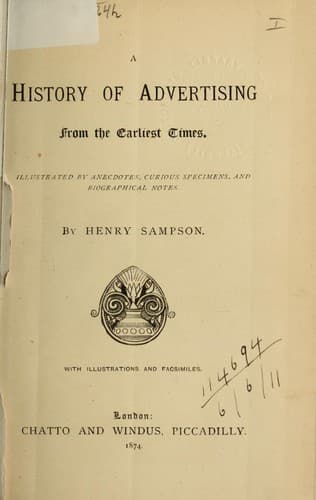
A History of Advertising from the Earliest Times.Sampson, Henry
History
A History of Advertising from the Earliest Times.
Sampson, Henry
Advertising -- History
LOSS of Memory, or Forgetfulness, certainly cured by a grateful
electuary peculiarly adapted for that end; it strikes at the primary
source, which few apprehend, of forgetfulness, makes the head clear
and easy, the spirits free, active, and undisturbed, corroborates and
revives all the noble faculties of the soul, such as thought,
judgment, apprehension, reason and memory, which last in particular it
so strengthens as to render that faculty exceeding quick and good
beyond imagination; thereby enabling those whose memory was before
almost totally lost, to remember the minutest circumstances of their
affairs, etc. to a wonder. Price 2s. 6d. a pot. Sold only at Mr
Payne’s, at the Angel and Crown, in St Paul’s Churchyard, with
directions.
It is sometimes possible to remember too much; and if the specific sold
by Mr Payne had but a homœopathic tendency, and caused those who
recollected things which never happened to become cured of their
propensities, it is a pity its recipe has to be numbered among the lost
things of this world. In the beginning of 1712, one Ephraim How seems to
have been possessed of a fear that evil folks had been trying to injure
him or his business, or else he felt it incumbent on himself to take the
hint thrown out in the _Tatler_ essay. Accordingly he published in the
_Daily Courant_ the following:--
WHEREAS several persons who sell knives, for the better vending their
bad wares spread reports that Ephraim How, Cutler of London is
deceased. This is to certify That he is living, and keeps his business
as formerly, with his son in partnership, at the Heart and Crown on
Saffron Hill; there being divers imitations, you are desired to
observe the mark, which is the Heart Crown and Dagger, with How under
it.
About this period shopkeepers were or pretended to be particularly
loyal, for a very large percentage of their signs contained the emblem
of royalty, coupled with various other figures. Though the Methuen
treaty, which favoured the importation of Portuguese wines, and
discouraged the use of claret, was signed in 1703, it does not appear to
have made much difference in this country for some years, as the first
mention we find of the new wine is in a _Postboy_ of January 1712, and
is caused by the rivalry which sprang up among those who first began to
sell it:--
Public-domain text, read in full here on John Shaqi.
Reviews
Reviews
No reviews yet
Be the first to share your thoughts on this work.
Elsewhere in the archive
Join the Discussion
Join the discussion
Sign in to leave a comment or review.
Sign InorCreate an account