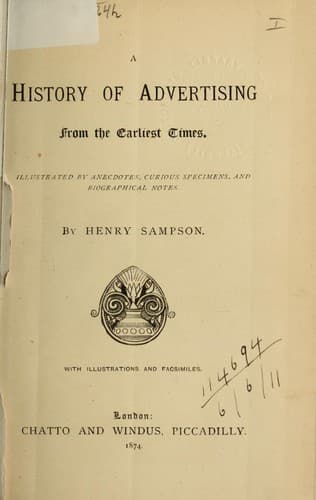
A History of Advertising from the Earliest Times.Sampson, Henry
History
A History of Advertising from the Earliest Times.
Sampson, Henry
Advertising -- History
Unnatural and unfeminine exhibitions, in accordance with this
advertisement, of pugilism, foot-racing, cudgel-playing, &c., were at
this time not unfrequent, and the spectacle of two women stripped to the
waist, and doing their best to injure or wear down each other, was often
enjoyed by the bloods of the early eighteenth century. At the same time
that the tax was placed on advertisements, the stamp-duty on newspapers
became an accomplished fact, and Swift in his journal to Stella of July
9, 1712, says, “Grub Street has but ten days to live, then an Act of
Parliament takes place that ruins it by taxing every half-sheet a
halfpenny.” And just about a month after, he chronicles the effect of
this cruelty: “Do you know that Grub Street is dead and gone last week?
No more ghosts or murders now for love or money. I plied it close the
last fortnight and published at least seven papers of my own, besides
some of other people’s; but now every single half-sheet pays a halfpenny
to the Queen. The _Observator_ is fallen; the _Medleys_ have jumbled
together with the _Flying Post_; the _Examiner_ is deadly sick; the
_Spectator_ keeps up and doubles its price. I know not how long it will
hold. Have you seen the red stamp the papers are marked with? Methinks
the stamping is worth a halfpenny.” Thieves about this time seem to have
had delicate susceptibilities, for it was the custom to advertise goods
which were undoubtedly stolen as lost. Thus we see constantly in the
reign of Queen Anne such notices as this: “Lost out of a room in Russell
Street a number of valuable objects.... Whoever brings them _back_ shall
have ten guineas reward, or in proportion for any part, and no questions
asked.” This style of advertising grew so that just about the middle of
the century it was found necessary to put a stop to it by Act of
Parliament, which took effect on the 21st of June 1752, the penalty
being £50 for any one who advertised “no questions asked,” and £50 for
the publisher who inserted any such notice in his paper. Haydn gives
this date as 1754, but a reference to the _General Advertiser_ of
February 21, 1752, in which the notice of the date on which the law is
to come into effect appears, shows that it was two years earlier. Also a
reference to any Parliamentary record of forty years before that will
show that not in 1713, as Haydn has it, but on the 22nd April 1712, Mr
Conyers reported from Committee of the whole House, who were considering
further ways and means for raising the supply granted to her Majesty;
when among other measures it was resolved that a duty of 12d. be charged
for every advertisement in any printed paper, besides the stamp-duty
which was at the same time imposed on the newspapers. This and other
extra taxes were levied, because France having refused to acknowledge
the title of Queen Anne till the peace should be signed, it was resolved
to continue the war “till a safe and honourable peace could be
Public-domain text, read in full here on John Shaqi.
Reviews
Reviews
No reviews yet
Be the first to share your thoughts on this work.
Elsewhere in the archive
Join the Discussion
Join the discussion
Sign in to leave a comment or review.
Sign InorCreate an account