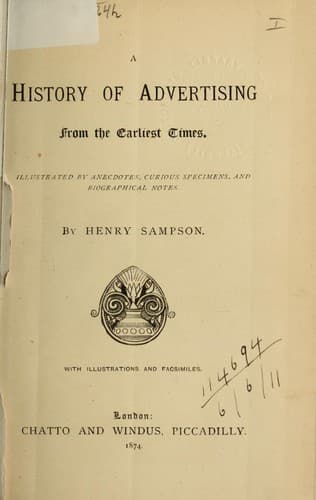
A History of Advertising from the Earliest Times.Sampson, Henry
History
A History of Advertising from the Earliest Times.
Sampson, Henry
Advertising -- History
The year 1720 is memorable in the history of England, as seeing the
abnormal growth and consequent explosion of the greatest swindle of
comparatively modern times, and one of the most colossal frauds of any
time, the South Sea Scheme, which has been best known since as the South
Sea Bubble. Its story has been told so often, and in so many ways, that
it is hardly necessary to dwell upon it here; but as, though nearly
every one has heard of the scheme, there are but few who know anything
about it, we may as well give once again a short _résumé_ of its
business operations. It was started by Harley in 1711, with the view of
paying off the floating national debt, which at that time amounted to
about £10,000,000. A contemporary writer says: “This debt was taken up
by a number of eminent merchants, to whom the Government agreed to
guarantee for a certain period the annual payment of £600,000 (being six
per cent. interest), a sum which was to be obtained by rendering
permanent a number of import duties. The monopoly of the trade to the
South Seas was also secured to these merchants, who were accordingly
incorporated as the ‘South Sea Company,’ and at once rose to a high
position in the mercantile world. The wondrously extravagant ideas then
current respecting the riches of the South American continent were
carefully fostered and encouraged by the Company, who also took care to
spread the belief that Spain was prepared, on certain liberal
conditions, to admit them to a considerable share of its South American
trade; and as a necessary consequence, a general avidity to partake in
the profits of this most lucrative speculation sprang up in the public
mind. It may be well to remark in this place, that the Company’s trading
projects had no other result than a single voyage of one ship in 1717,
and that its prominence in British history is due entirely to its
existence as a purely monetary corporation. Notwithstanding the absence
of any symptoms of its carrying out its great trading scheme, the
Company had obtained a firm hold on popular favour, and its shares rose
day by day; and even when the outbreak of war with Spain in 1718
deprived the most sanguine of the slightest hope of sharing in the
treasures of the South Seas, the Company continued to flourish. Far from
being alarmed at the expected and impending failure of a similar
project--the Mississippi Scheme--the South Sea Company believed
sincerely in the feasibility of Law’s Scheme, and resolved to avoid what
they considered as his errors. Trusting to the possibility of pushing
credit to its utmost extent without danger, they proposed, in the spring
of 1720, to take upon themselves the whole national debt (at that time
£30,981,712) on being guaranteed 5 per cent. per annum for seven and a
half years, at the end of which time the debt might be redeemed if the
Government chose, and the interest reduced to 4 per cent. The directors
of the Bank of England, jealous of the prospective benefit and influence
Public-domain text, read in full here on John Shaqi.
Reviews
Reviews
No reviews yet
Be the first to share your thoughts on this work.
Elsewhere in the archive
Join the Discussion
Join the discussion
Sign in to leave a comment or review.
Sign InorCreate an account