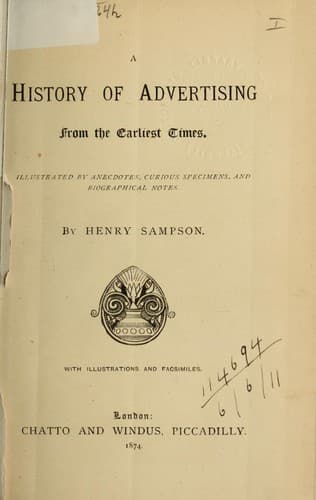
A History of Advertising from the Earliest Times.Sampson, Henry
History
A History of Advertising from the Earliest Times.
Sampson, Henry
Advertising -- History
I, Elizabeth Stokes, of the City of London, have not fought in this
way since I fought the famous boxing woman of Billingsgate 29 minutes
and gained a complete victory (which is six years ago); but as the
famous Stoke Newington ass-woman dares me to fight her for the 10
pounds, I do assure her I will not fail meeting her for the said sum,
and doubt not that the blows which I shall present her with will be
more difficult for her to digest, than any she ever gave her asses.
_Note._--A man known by the name of Rugged and Tuff, challenges the
best man of Stoke Newington to fight him for one guinea to what sum
they please to venture. _N.B._--Attendance will be given at one, and
the encounter to begin at four precisely. There will be the diversion
of cudgel-playing as usual.
Pugilism was evidently a much valued accomplishment among the
lower-class ladies in 1728, and there is no doubt that Mrs Stokes and
Mrs Field were considered very estimable persons as well as great
athletes in their respective circles. There is, moreover, a suspicion of
humour about the reference to the asses in the reply of Mrs Stokes. In
the happily-named Rugged and Tuff we see the forerunner of that line of
champions of the ring which, commencing with Figg and Broughton, ran
unbroken up to comparatively modern days. Other advertisements about
this period relate to cock-matches and mains, sometimes specified to
“last the week,” to bull-baiting in its ordinary and sometimes in its
more cruel form of dressing up the beasts with fireworks, so as to
excite both them and the savage dogs to their utmost. Perhaps brutality
was never so rampant, or affected so many phases of society as it did in
the first half of the eighteenth century. Slavery was considered a
heaven-born institution, not alone as regards coloured races, for
expeditions to the Plantations went on merrily and afforded excellent
opportunities for the disposal of any one who happened to make himself
objectionable by word or deed, or even by his very existence. The wicked
uncle with an eye on the family property had a very good time then, and
the rightful heir was often doomed to a slavery almost worse than death.
Apropos of slavery, we may as well quote a very short advertisement
which shows how the home trade flourished in 1728. It is from the _Daily
Journal_ of September 28:--
TO be sold, a Negro boy, aged eleven years. Enquire of the Virginia
Coffee-house in Threadneedle street, behind the Royal Exchange.
Negroes had in 1728 become quite common here, and had pushed out their
predecessors, the Moors and Asiatics, who formerly held submissive
servitude. This was probably owing to the nefarious traffic commenced in
1680 by Hawkins, which in little more than a hundred years caused the
departure from their African homes and the transplanting in Jamaica
alone of 910,000 negroes, to say nothing of those who died on the
voyage, or who found their way to England and other countries.
Public-domain text, read in full here on John Shaqi.
Reviews
Reviews
No reviews yet
Be the first to share your thoughts on this work.
Elsewhere in the archive
Join the Discussion
Join the discussion
Sign in to leave a comment or review.
Sign InorCreate an account