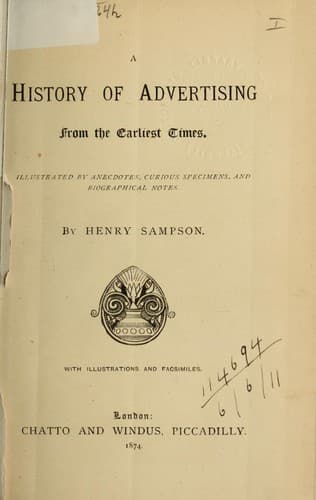
A History of Advertising from the Earliest Times.Sampson, Henry
History
A History of Advertising from the Earliest Times.
Sampson, Henry
Advertising -- History
A. Z. must have been possessed of a considerable amount of faith if he
believed that the rufflers who set upon him unawares would consent
either to expose themselves, or to give what he and others called, in a
thoughtless manner, “the satisfaction of a gentleman.” It must have
been rare satisfaction at any time to be run through the body or shot
through the head, after having been insulted or injured. In the _London
Daily Post and General Advertiser_, shortly after this (February 5,
1739-40), is an advertisement which looks suspiciously like a hoax,
unless, indeed, it was believed at the time that one swallow would make
a summer. As the advertiser was probably devoted to the agricultural
interest, this is a not unlikely solution of the problem, more
especially as a caged bird would naturally not be expected to possess
the desired power:--
IF any person will deliver a Swallow, Swift (commonly called a Jack
Squeeler) or Martin, alive to Mr Thomas Meysey, at Bewdley in
Worcestershire, before the 22d day of this instant February, he shall
have Ten Guineas Reward paid him, and all reasonable charges allowed
him for his journey by the said Thomas Meysey: Or if any person will
deliver either of the said birds to Mr John Perrins, Distiller, in
Butcher Row, London, soon enough to send it to the said Thomas Meysey
at Bewdley before the 22d Instant February, and the bird shall be
alive when delivered, or come to live after it is delivered to the
said Thomas Meysey, he shall have Ten Guineas Reward paid him, and all
reasonable charges allowed him by the said John Perrins.
These birds are oftentimes found in the clifts in great rocks, old
chimneys, and old houses, seemingly dead; but when they are put before
a fire, they will come to life.
_N.B._--It must not be a Swallow, Swift or Martin that has been kept
in a cage.
There must have been much capturing of small birds, and many may have
been roasted alive in attempts to preserve them for the benefit of
Thomas Meysey. It certainly does appear as if about this time humour was
so rife that it had to find vent in all sorts of strange advertisements,
and the quacks were not slow to follow the lead thus set, as is shown by
the exercising swindle which follows, and which certainly must have
exercised the minds of many who read it at the time. It appears in the
same paper as the foregoing, on March 7, 1739-40. (It is almost time by
March to know what year one is in.)
FULLER _on_ EXERCISE.
(_A Book worth reading_)
Public-domain text, read in full here on John Shaqi.
Reviews
Reviews
No reviews yet
Be the first to share your thoughts on this work.
Elsewhere in the archive
Join the Discussion
Join the discussion
Sign in to leave a comment or review.
Sign InorCreate an account