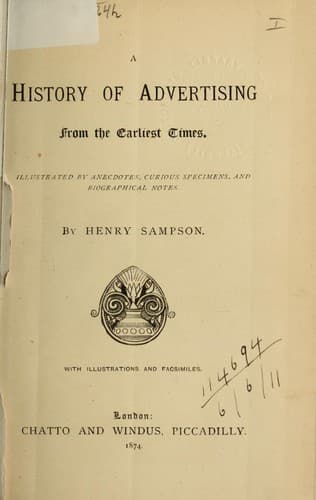
A History of Advertising from the Earliest Times.Sampson, Henry
History
A History of Advertising from the Earliest Times.
Sampson, Henry
Advertising -- History
THAT since his decease she hath followed the same business, and lives
at the house of Mrs Mary Roundhall, in Bearlane, Christ Church Parish,
Southwark. Such quality and gentry as are troubled with buggs, and are
desirous to be kept free from those vermin, may know, on sending their
commands to her lodgings aforesaid, when she will agree with them on
easy terms, and at the first sight will justly tell them which of
their beds are infested, &c., and which are free, and what is the
expense of clearing the infested ones, never putting any one to more
expense than necessary.
Persons who cannot afford to pay her price, and is willing to destroy
them themselves, may by sending notice to her place of abode
aforesaid, be furnish’d with the NON PAREIL LIQUOR, &c. &c.
Bugs are said to have been very little if at all known in the days of
our ancestors. It is indeed affirmed in that valuable addition to
zoology, Southall’s “Treatise of Bugs” (London, 1730, 8vo), referred to
in the advertisement just quoted, that this insect was scarcely known in
England before the year 1670, when it was imported among the timber used
in rebuilding the city of London after the fire of 1666. That it was,
however, known much earlier is not to be doubted, though probably it was
far less common than at present, since Dr Thomas Muffet, in the
“Theatrum Insectorum,” informs us that Dr Penny, one of the early
compilers of that history of insects, relates his having been sent for
in great haste to Mortlake in Surrey, to visit two noble ladies who
imagined themselves seized with symptoms of the plague; but on Penny’s
demonstrating to them the true cause of their complaint--viz., having
been bitten by those insects, and even detecting them in their
presence--the whole affair was turned into a jest. This was in the year
1583. It is a somewhat remarkable fact, well known to those whose
misfortunes subject them to contiguity with these highly-scented
bloodsuckers, that within the past few years bugs have altered
considerably. The old, nearly round-bellied, and possibly jovial fellow,
has given way to a long dangerous creature who is known to experts as
the “omnibus bug,” not so much on account of his impartiality as because
of his shape. It is believed by some that this change is the result of
bugs being discontented with their position, and their natural (and
laudable) attempt to become something else in accordance with scientific
theory; but we fancy that the true reason of this change is that foreign
bugs have been imported in large numbers among cargoes, and not
infrequently about passengers, and that the original settlers are being
gradually exterminated in a manner similar to that which led to the
extirpation of the black rat in this country. There is yet another
theory with regard to the change which it would be unfair to pass over.
It is that the bugs have altered--it is admitted on all sides that the
Public-domain text, read in full here on John Shaqi.
Reviews
Reviews
No reviews yet
Be the first to share your thoughts on this work.
Elsewhere in the archive
Join the Discussion
Join the discussion
Sign in to leave a comment or review.
Sign InorCreate an account