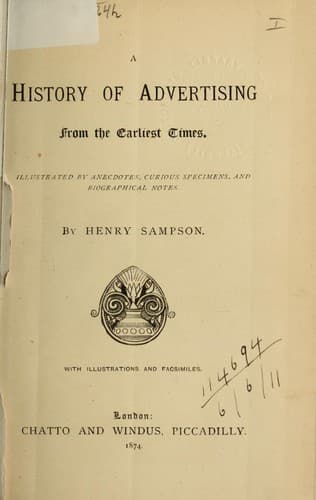
A History of Advertising from the Earliest Times. — John Shaqi
A History of Advertising from the Earliest Times.Sampson, Henry
History
A History of Advertising from the Earliest Times.
Sampson, Henry
Advertising -- History
book, quotes Aristotle, and refers to Lucian, Aristophanes, and others,
in proof of the fact that signboard advertisements were used in ancient
Greece, but the information is extremely vague. Of the Romans, however,
more is known. Some streets were with them known by means of signs. The
book referred to tells us that the bush, the Romans’ tavern sign, gave
rise to the proverb, “Vino vendibili suspensa hedera non opus est;” and
hence we derive our own sign of the bush, and our proverb, “Good wine
needs no bush.” An _ansa_ or handle of a pitcher was then the sign of a
pothouse, and hence establishments of this kind were afterwards
denominated _ansæ_.
A correspondent writing to _Notes and Queries_, in answer to a question
in reference to early advertising, says that the mode adopted by the
Hebrews appears to have been chiefly by word of mouth, not by writing.
Hence the Hebrew word _kara_ signifies to cry aloud, and to announce or
make known publicly (κηρύσσειν); and the announcement or proclamation,
as a matter of course, was usually made in the streets and chief places
of concourse. The matters thus proclaimed were chiefly of a sacred kind,
as might be expected under a theocracy; and we have no evidence that
secular affairs were made the subject of similar announcements. In one
instance, indeed (Isa. xiii. 3), _kara_ has been supposed to signify the
calling out of troops; but this may be doubted. The Greeks came a step
nearer to our idea of advertising, for they made their public
announcements by writing as well as orally. For announcement by word of
mouth they had their κήρυξ, who, with various offices besides, combined
that of public crier. His duties as crier appear to have been
restricted, with few exceptions, to state announcements and to great
occasions. He gave notice, however, of sales. For the publication of
their laws the Greeks employed various kinds of tablets, πίνακες,
ἄξονες, κύρβεις. On these the laws were written, to be displayed for
public inspection. The Romans largely advertised private as well as
public matters, and by writing as well as by word of mouth. They had
their _præcones_, or criers, who not only had their public duties, but
announced the times, places, and conditions of sales, and cried things
lost. Hawkers cried their own goods. Thus Cicero speaks of one who cried
figs, _Cauneas clamitabat_ (De Divin. ii. 40). But the Romans also
advertised, in a stricter sense of the term, by writing. The bills were
called _libelli_, and were used for advertising sales of estates, for
absconded debtors, and for things lost or found. The advertisements were
often written on tablets (_tabellæ_), which were affixed to pillars
(_pilæ columnæ_). On the walls of Pompeii have been discovered various
advertisements. There will be a dedication or formal opening of certain
baths. The company attending are promised slaughter of wild beasts,
athletic games, perfumed sprinkling, and awnings to keep off the sun
Public-domain text, read in full here on John Shaqi.
Reviews
Reviews
No reviews yet
Be the first to share your thoughts on this work.
Join the Discussion
Join the discussion
Sign in to leave a comment or review.
Sign InorCreate an account