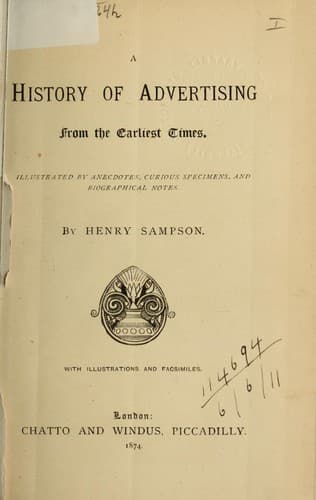
A History of Advertising from the Earliest Times.Sampson, Henry
History
A History of Advertising from the Earliest Times.
Sampson, Henry
Advertising -- History
(_venatia_, _athletæ_, _sparsiones_, _vela_).[4] One other mode of
public announcement employed by the Romans should be mentioned, and that
was by signs suspended or painted on the wall. Thus a suspended shield
served as the sign of a tavern (Quintil. vi. 3), and nuisances were
prohibited by the painting of two sacred serpents. Among the French,
advertising appears to have become very general towards the close of the
sixteenth century. In particular, placards attacking private character
had, in consequence of the religious wars, become so numerous and
outrageous, that subsequently, in 1652, the Government found it
necessary to interpose for their repression.[5]
Speaking of the signs of Herculaneum and Pompeii, the “History of
Signboards” says that a few were painted, but, as a rule, they appear to
have been made of stone, or terra cotta relievo, and set into the
pilasters at the sides of the open shop fronts. Thus there have been
found a goat, the sign of a dairy, and a mule driving a mill, the sign
of a baker. At the door of a school was the highly suggestive and not
particularly pleasant sign to pupils of a boy being birched. Like to our
own signs of two brewers carrying a tun slung on a pole, a Pompeian
publican had two slaves represented above his door carrying an amphora,
and another dispenser of drink had a painting of Bacchus pressing a
bunch of grapes. At a perfumer’s shop in the street of Mercury were
represented various items of that profession, notably four men carrying
a box with vases of perfume, and men laying out and perfuming a corpse.
There was also a sign of the Two Gladiators, under which, in the usual
Pompeian cacography, was the following:--“Abiam venerem Pompeiianama
iradam qui hoc læserit.” Besides these were the signs of the Anchor, the
Ship (possibly a ship-chandler’s), a sort of a Cross, the Chequers, the
Phallus on a baker’s shop, with the words, “Hic habitat felicitas;”
whilst in Herculaneum there was a very cleverly painted Amorino, or
Cupid, carrying a pair of lady’s shoes, one on his head and the other in
his hand. It is also probable that the various artificers of Rome used
their tools as signs over their workshops and residences, as it is found
that they were sculptured on their tombs in the catacombs. On the
tombstone of Diogenes, the grave-digger, there is a pickaxe and a lamp;
Banto and Maxima have the tools of carpenters, a saw, an adze, and a
chisel; Veneria, a tire-woman, has a mirror and a comb. There are others
with wool-combers’ implements; a physician has a cupping-glass; a
poulterer, a case of fowls; a surveyor, a measuring rule; a baker, a
bushel measure, a millstone, and some ears of corn; and other signs are
numerous on the graves of the departed. Even the modern custom of
punning on the name, so common on signboards, finds its precedent on
these stones. The grave of Dracontius was embellished with a dragon,
that of Onager with a wild ass, and that of Umbricius with a shady tree.
Public-domain text, read in full here on John Shaqi.
Reviews
Reviews
No reviews yet
Be the first to share your thoughts on this work.
Join the Discussion
Join the discussion
Sign in to leave a comment or review.
Sign InorCreate an account