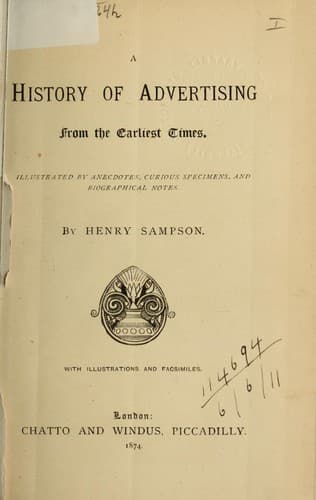
A History of Advertising from the Earliest Times.Sampson, Henry
History
A History of Advertising from the Earliest Times.
Sampson, Henry
Advertising -- History
Poetical advertisements were not at all uncommon a hundred years ago and
less. The demand for space, and the steam-engine rate at which we live
now, have, however, destroyed not only the opportunity for them, but
their use. Towards the close of the last century there lived in the
Canongate, Edinburgh, one Gavin Wilson, a hard-working bootmaker, or, as
his sign described him, “Arm, Leg and Boot maker, _but not_ to his Royal
Highness the Prince of Wales.” He was a singular fellow, and was the
inventor of an art for hardening and polishing leather, so as to be
workable into powder-flasks, snuff-boxes, drinking-mugs, ink-cases, and
other articles of a similar kind. His genius did not stop at this rough
work, but enabled him to form a German flute and a violin, both of
leather, which, for neatness of workmanship and melodiousness of tone,
were, friendly critics said, not a bit inferior to any fiddle or flute
formed of wood. His greatest triumphs, however, were artificial arms and
legs, also made of leather, which not only completely remedied loss of
limb, but also closely resembled their human prototypes, being covered
with skin, nails, &c. The unexampled success of his endeavours in this
way was curiously illustrated by a person who, having lost both his
hands by a cannon-shot, was provided with a new and useful pair by Gavin
Wilson. This man expressed his gratitude in a letter of thanks, written
with the artificial hands, which appeared in the _Caledonian Mercury_
for 1779, along with an advertisement of the ingenious mechanic. Wilson
had also pretensions to wit, and was occasionally a votary of what Foote
once described as the Tuneful Ten. “Nine and one are ten,” said Foote
one day to an accountant, who was anxious the wit should hear his
poetry, and who commenced, “Hear me, O Phœbus and ye Tuneful Nine!”
Having got so far, he accused Foote of inattention; but the latter
said, “Nine and one are ten--go on,” which was too near the shop to be
pleasant. The following advertisement may serve as a specimen of
Wilson’s poetical attempts:--
Public-domain text, read in full here on John Shaqi.
Reviews
Reviews
No reviews yet
Be the first to share your thoughts on this work.
Elsewhere in the archive
Join the Discussion
Join the discussion
Sign in to leave a comment or review.
Sign InorCreate an account