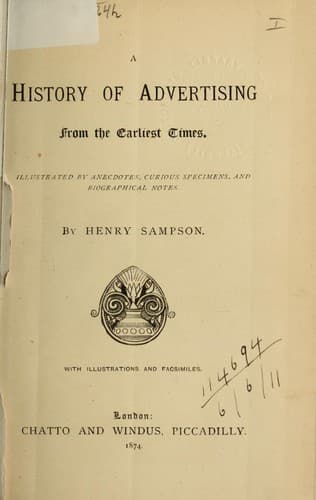
A History of Advertising from the Earliest Times.Sampson, Henry
History
A History of Advertising from the Earliest Times.
Sampson, Henry
Advertising -- History
RUN AWAY FROM PATRICK M‘DALLAGH.--Whereas my wife Mrs Bridget
M‘Dallagh, is again walked away with herself, and left me with her
four small children, and her poor old blind mother, and nobody else to
look after house and home, and, I hear, has taken up with Tim Guigan,
the lame fiddler--the same that was put in the stocks last Easter for
stealing Barday Doody’s gamecock.--This is to give notice, that I will
not pay for bite or sup on her or his account to man or mortal, and
that she had better never show the mark of her ten toes near my home
again.
PATRICK M‘DALLAGH.
N.B. Tim had better keep out of my sight.
Mrs Bridget seems to have been in the habit of straying from the path of
virtue and her husband’s home, which, if we are to believe Irish poets
and orators, must have been very exceptional behaviour in the land of
“virtue and Erin.” As if to provide against similar emergency, a
Parisian puts forth an advertisement, the translation of which runs
thus:--
A gentleman in his twenty-sixth year, tired of the dissipation of the
great world, is forming a comfortable establishment in one of the
least frequented quarters of the city. His domestics are a coachman,
cook, three footmen and a chambermaid. He is in search of a young girl
of good family to improve this honourable situation: she must be well
educated, accomplished, and of an agreeable figure, and will be
entertained in the quality of _demoiselle de compagnie_. She shall
receive the utmost attention from the household, and be as well served
in every respect as, or even better than, if she were its mistress.
As just now there is constant change of opinion as to what forms the
best pavement for the streets with the greatest traffic, as the stones
which seemed to be agreed on for ever are every day becoming more and
more disliked, and as the main difference now is which is likely to
prove the more profitable change, asphalt or wood, the following, from
the _Times_ of 1851, may not be uninteresting:--
WOOD PAVEMENT.--All poor and distressed cabriolet proprietors and
others, wheresoever dispersed, are particularly requested to FORWARD
to us immediately PROVED ACCOUNTS in writing of all ACCIDENTS to and
DEATHS of HORSES, and Personal and other Casualties, in order that the
several parishes may respectfully, in the first place be
extra-judicially called on to repay all damages (at our offices),
within one calendar month of our respective applications, or otherwise
have proceedings taken against them respectively in the County Courts,
or under superior jurisdictions, and be so judicially and speedily
made to pay on account of entering into ex-parte contracts rendering
life and limb and travelling generally unsafe and dangerous in the
extreme, and so continuing the bad state of the wood pavement; for no
contracts can be lawful and right unless impliedly perused and
approved of on behalf of the public generally.
Public-domain text, read in full here on John Shaqi.
Reviews
Reviews
No reviews yet
Be the first to share your thoughts on this work.
Elsewhere in the archive
Join the Discussion
Join the discussion
Sign in to leave a comment or review.
Sign InorCreate an account